A standard off-the-shelf camera system will fail you exactly when you need it most; during a 40-degree Brisbane summer or a February supercell storm. You already understand that protecting your commercial assets requires more than a basic Wi-Fi connection and a prayer. With commercial break-ins in Brisbane industrial pockets like Rocklea and Acacia Ridge rising by 14% since early 2024, the stakes for professional security systems brisbane qld have never been higher. It’s about more than just having cameras; it’s about ensuring your infrastructure survives the QLD humidity and provides high-definition evidence that actually stands up in a courtroom.
This guide offers a comprehensive, boots-on-the-ground roadmap for evaluating and installing industrial-grade tech that keeps your site secure. We’ll cut through the confusion between cheap DIY hardware and professional solutions to ensure your installation is fully insurance-compliant. You’ll learn how to select moisture-sealed components that won’t fog up during the wet season and how to position sensors to deter intruders before they reach your perimeter. From initial mobilization to final compliance checks, this 2026 checklist delivers the technical edge your business needs to stay operational and protected.
Key Takeaways
- Identify how Brisbane’s unique environmental factors, such as salt air and humidity, dictate your hardware choices for long-term reliability in industrial zones.
- Evaluate high-performance security systems brisbane qld by moving beyond basic alarms to intelligent 4K detection systems that provide actionable commercial evidence.
- Ensure your business stays compliant with the QLD Security Provider Act and Australian privacy laws to avoid legal pitfalls during and after installation.
- Optimise your facility’s network infrastructure and NBN bandwidth to support a seamless, high-definition security rollout across large-scale sites.
- Learn how to select a local partner who treats security as a strategic asset, prioritising “boots on the ground” expertise and operational integrity.
The Brisbane Security Landscape: Assessing Your Local Risks
Brisbane businesses face diverse threats depending on their specific postcode. A warehouse in Murarrie near the Port handles different risks than a retail shop in the CBD or a construction site in Logan. Effective security systems brisbane qld require a strategy that moves beyond off-the-shelf kits. You need a “boots on the ground” audit to find blind spots in your perimeter before an incident occurs. Data from the Queensland Police Service in 2023 shows property crime rates vary by up to 40% between industrial hubs and residential fringes. Identifying your primary goal is the first step. Are you looking for active deterrence, high-resolution evidence collection, or strict access management? Establishing these physical security measures ensures your investment protects your actual assets rather than just ticking a compliance box.
Brisbane-Specific Risk Profiling
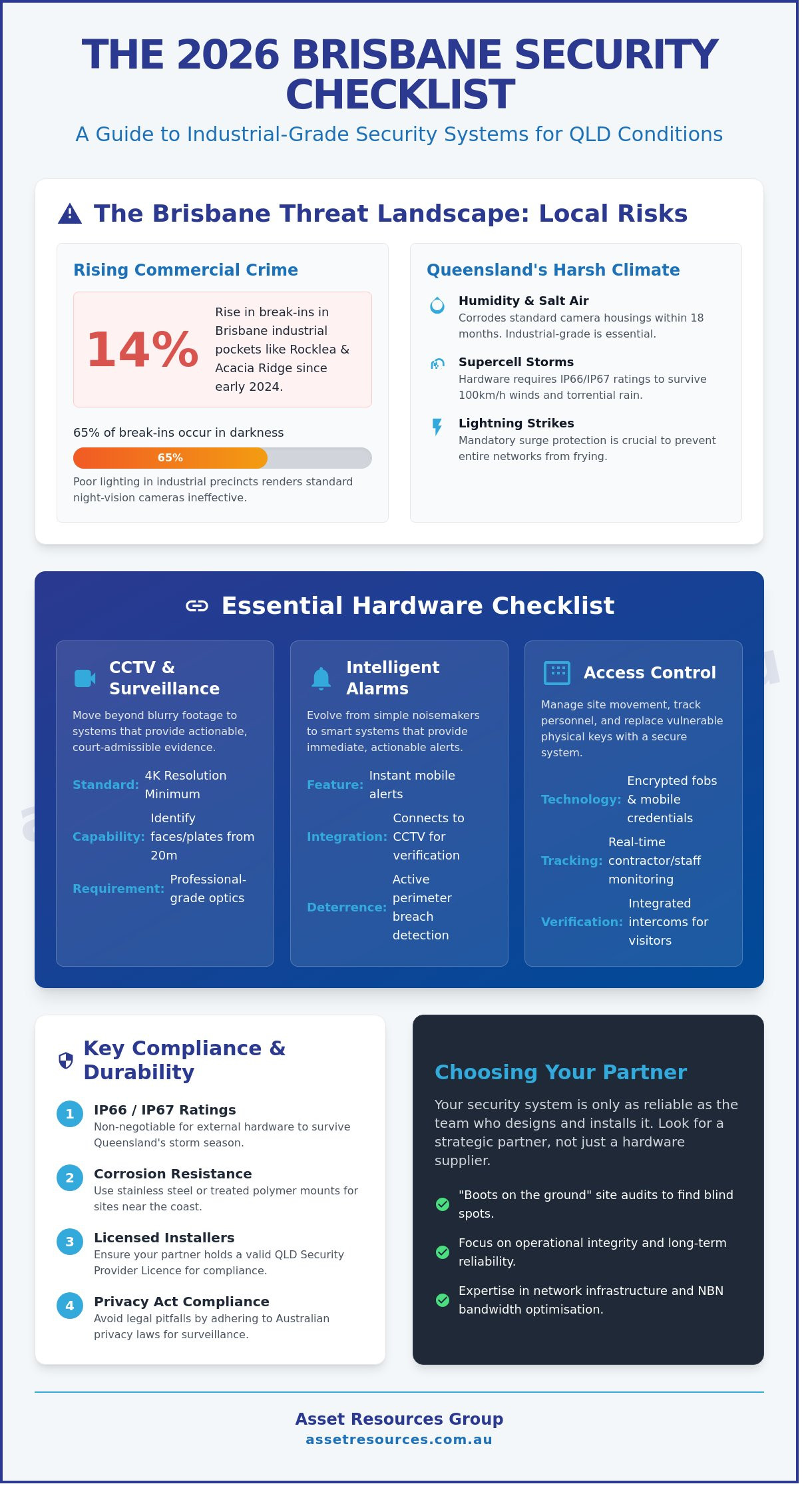
Generic systems often fail in South East Queensland’s high-traffic commercial zones. Sites in Wacol or Acacia Ridge often deal with poor street lighting, which renders standard night-vision cameras useless. You need sensors and optics tailored to these specific conditions. Recent crime statistics indicate that 65% of commercial break-ins occur under the cover of darkness in poorly illuminated industrial precincts. A tailored profile considers your site’s unique layout and local crime trends to ensure your hardware actually performs when it’s needed most. Don’t settle for a one-size-fits-all approach that leaves your blind spots exposed.
Environmental Durability Checklist
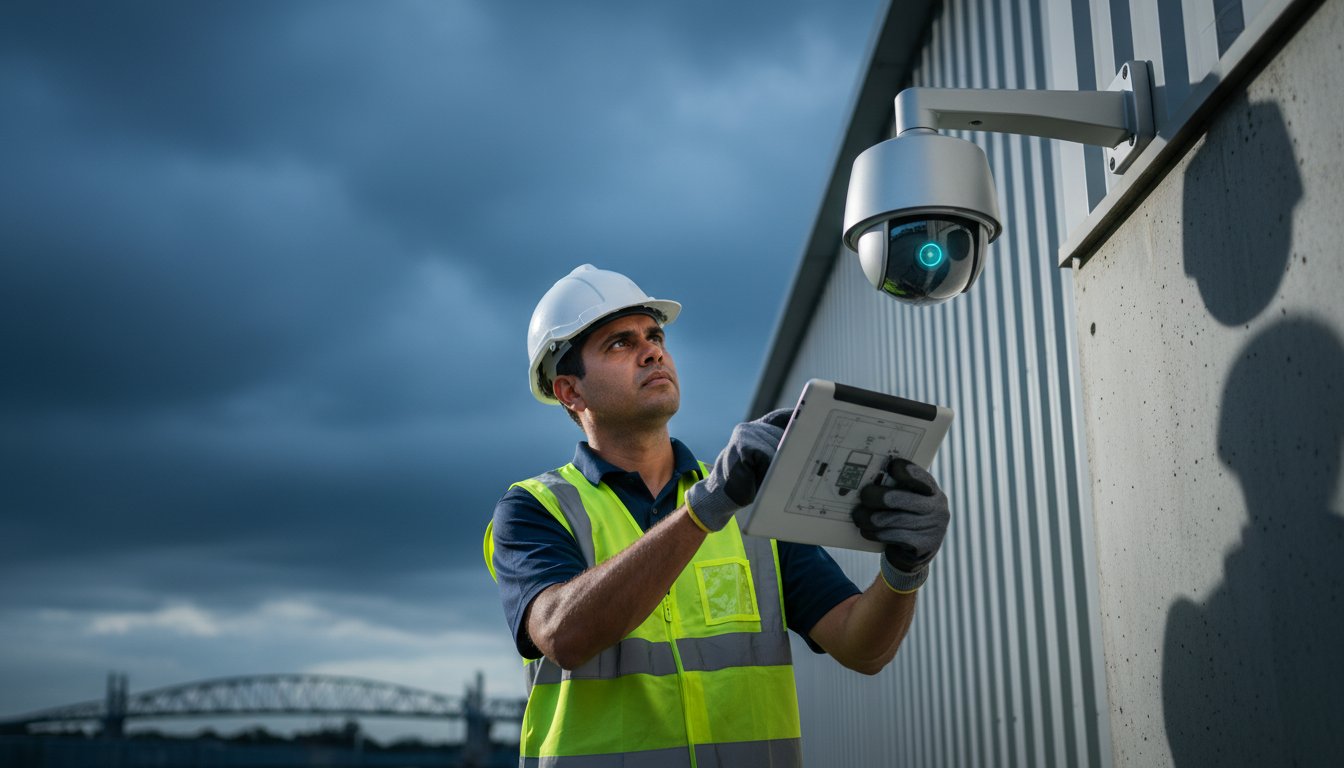
Queensland’s climate is brutal on hardware. Brisbane’s high humidity and the salt air near the Port can corrode standard camera housings within 18 months if they aren’t industrial grade. Your security systems brisbane qld must be built to withstand local conditions.
- IP66 and IP67 Ratings: These are essential for surviving the 100km/h winds and heavy downpours typical of the October to March storm season.
- Corrosion Resistance: Use stainless steel or treated polymer mountings for any site within 5km of the coastline to prevent structural failure.
- Surge Protection: South East QLD experiences some of Australia’s highest lightning strike frequencies. Dedicated surge protection is mandatory to prevent your entire network from frying during a summer electrical storm.
Reliability in the field comes down to selecting hardware that’s as tough as the environment it protects. We’ve seen too many systems fail because they weren’t rated for the Queensland heat or the sudden intensity of a Brisbane afternoon storm.
Essential Hardware Checklist: CCTV, Alarms, and Access Control
Reliable security systems brisbane qld require more than just a few cameras and a loud siren. In the current industrial climate, your hardware must provide actionable data, not just grainy footage. By 2026, 4K resolution will be the minimum baseline for commercial evidence. High-definition clarity ensures you can identify faces and number plates from 20 metres away, which is vital for police investigations or insurance claims. Modern intruder alarms have also evolved. They’ve shifted from simple noise-makers to intelligent systems that send instant mobile alerts the moment a perimeter is breached.
Managing movement on-site is equally critical for operational integrity. Access control replaces physical keys with encrypted fobs or mobile credentials, allowing you to track contractor movement in real-time. This technology pairs with intercom systems at entry gates, enabling site managers to verify visitors visually before granting access. When hiring an installer, ensure they hold a valid Queensland security provider licence to guarantee your hardware meets state compliance standards.
CCTV & Surveillance Standards
Industrial sites shouldn’t rely on consumer-grade kits found in retail stores. Professional security systems brisbane qld utilize NDAA-compliant hardware to prevent cybersecurity vulnerabilities and ensure long-term reliability. Look for systems that maintain a minimum of 20 frames per second and offer storage capacity for at least 30 days of 24/7 recording. AI-driven deterrence is now a standard requirement; these cameras use thermal sensors and blue-red strobe lights to warn intruders they’re being watched before they even touch a fence line.
Integrated Alarm & Access Solutions
Integration is where true site safety happens. When an alarm triggers, your system should automatically pull up the nearest camera feed for “video verification.” This process reduces false call-out fees by up to 90% and ensures a rapid response from authorities. Access control logs create a digital paper trail, recording exactly when staff or assets move through specific zones. You can manage these remote Brisbane sites from a single mobile app, allowing for instant lock-downs or gate releases. If you’re looking to upgrade your facility’s protection, consider how tailored security solutions can streamline your operational oversight.
Regulatory & Compliance Checklist: Meeting QLD Security Standards
Compliance isn’t just about ticking boxes; it’s about protecting your liability and ensuring your insurance policy actually pays out when you need it. In Queensland, the security sector is strictly regulated to prevent unlicensed operators from compromising public safety. When sourcing security systems brisbane qld, your first move is verifying that the provider holds a current QLD Security Firm Class 2 license. This specific credential authorizes them to install, maintain, and repair security equipment professionally.
The Security Providers Act 1993 serves as the primary legislation regulating the licensing and conduct of security firms and individuals to ensure high standards of integrity across the Queensland industry. Hiring an unlicensed “handyman” for a commercial install is a high-stakes gamble. If a break-in occurs and your system fails, an insurer like QBE or Allianz can legally deny a claim for A$20,000 or more in damages because the installation didn’t meet Australian Standard AS 2201. You can verify any company’s credentials instantly through the Queensland Government’s Office of Fair Trading online portal.
Licensing & Professionalism
A professional installation does more than catch intruders; it lowers your overheads. Most Australian commercial insurers offer premium discounts of up to 15% when you provide a Certificate of Compliance from a licensed installer. This document proves the system was designed to mitigate specific risks. Don’t settle for a verbal assurance. Demand to see the installer’s individual Class 2 license card before they touch your wiring. It’s the only way to guarantee they’ve passed the required criminal history checks and competency training mandated by the QLD Police.
Data Privacy & Ethics
Privacy laws in Australia are stringent. Under the Privacy Act 1988, your business must be transparent about its surveillance activities. You’re legally required to display “CCTV in Operation” signage at all primary entry points to notify staff and the public. Pointing cameras at public footpaths or neighboring private property can lead to heavy fines or civil litigation. Stick to your perimeter and internal high-value zones.
Managing the data is just as critical as capturing it. You must implement a clear policy for data storage and footage access that aligns with the Australian Privacy Principles (APPs). If the Queensland Police Service (QPS) requests footage for an investigation, you need a streamlined process to provide that data without compromising the privacy of uninvolved third parties. Keep your recording servers in a secure, locked rack to prevent unauthorized tampering or data theft.
The Installation & Integration Checklist: Planning Your Site Rollout
A successful rollout of security systems brisbane qld depends on the technical groundwork laid before a single drill touches the wall. We start with a comprehensive pre-install site survey. This involves mapping cable runs for hardwired PoE cameras and establishing wireless bridges for expansive 10,000sqm facilities where physical cabling is cost-prohibitive. Your network infrastructure must be ready for the load. High-definition 4K video streams often consume 8 to 10 Mbps per camera. Without a robust business NBN plan and managed switches, your network will bottleneck during critical recording events.
Integration turns standalone hardware into a functional ecosystem. We link your intercom, automated gates, and alarm panels into a single management interface. This eliminates the “fragmentation gap” where security data gets lost between different apps. Once the hardware is live, we focus on staff training. Your security system is a high-value asset. If your site manager can’t pull footage for a WorkCover claim within 60 seconds, the investment hasn’t reached its full potential. We ensure every authorized user is confident with the interface before we leave the site.
Strategic Hardware Placement
Coverage starts at the perimeter. We prioritize overlapping fields of view at loading docks and entry points to eliminate the 15% blind spot margin often found in generic setups. Control panels and NVR recorders belong in secure, climate-controlled rooms. Heat is the primary killer of hard drives in South East Queensland. Internal cabinet temperatures can exceed 55°C without proper ventilation, leading to premature disk failure and lost data.
Post-Installation Support
Installation is just the beginning of the lifecycle. A 12-month scheduled maintenance plan is standard for Brisbane industrial sites to combat salt air corrosion and dust build-up. We also manage firmware updates to patch vulnerabilities. Cyber threats targeted at IoT devices increased by 400% in 2023, making regular software audits vital for compliance. Finally, we test your Uninterruptible Power Supply (UPS). A 2kVA UPS ensures your security systems brisbane qld stay recording for at least 30 minutes during a local grid failure.
Ensure your facility is protected by experts who understand industrial mobilization and site safety. Partner with Asset Resources for reliable, professional security solutions today.
Choosing Your Brisbane Security Partner: The ARG Difference
Asset Resources Group (ARG) doesn’t treat protection as a simple checkbox exercise. We view security as a critical asset. Our philosophy integrates integrity with technical precision to protect your people and high-value property across South East Queensland. We move beyond generic, out-of-the-box setups. Instead, we design tailored systems that address the specific vulnerabilities of your site. This ensures every security systems brisbane qld installation delivers a measurable return through loss prevention and rigorous risk mitigation. We prioritize long-term partnerships, supporting you from the first day of mobilization through years of technical maintenance.
Why Local Knowledge Matters
Our team brings decades of experience securing Brisbane’s mining, civil, and construction assets. We understand the unique logistical challenges of the Moreton Bay region because our roots are here. Having technicians based in Griffin allows us to provide rapid response times that national providers simply can’t match. This local presence means our “safety-first” quality standard is applied personally to every project. We’ve successfully managed security mobilizations for projects ranging from local commercial builds to multi-million dollar civil infrastructure works across the 4000 and 4500 postcodes. We know the terrain, the risks, and the regulatory requirements of the Queensland industrial landscape.
Getting Started with Asset Resources Group
The ARG process is built on clarity and results. It starts with a comprehensive site consultation and concludes with a professional handover. We don’t just hand you a manual and walk away. Our experts ensure your team knows how to leverage advanced technology to its full potential. We specialize in high-stakes environments where we integrate the following:
- Thermal Imaging: For 24/7 perimeter detection in low-visibility conditions.
- Drone Surveillance: To provide rapid aerial assessments of large-scale civil and mining sites.
- Customized Design: Hardware configurations built for the harsh Australian climate.
Our commitment to your project doesn’t end at the gate. We provide ongoing technical support to ensure your security systems brisbane qld remain compliant and operational. Ready to harden your site’s defenses? Book your Brisbane site security audit with Asset Resources Group today and secure your assets with a partner who understands the high-stakes nature of your industry.
Future-Proof Your Brisbane Commercial Assets
Securing a commercial site in 2026 demands a proactive strategy that aligns with the Security Providers Act 1993 and updated QLD licensing requirements. You’ve identified that high-definition 4K integration and multi-layered access control are no longer optional extras; they’re the foundation of site integrity. As a QLD Licenced Security Provider with deep South East Queensland regional expertise, ARG delivers the technical precision needed for complex industrial rollouts. We focus on clear, functional results that protect your staff and your bottom line without the fluff.
Selecting the right security systems brisbane qld determines how effectively you mitigate local risks and maintain insurance compliance across your facility. Our specialists in high-definition commercial integration provide the “boots on the ground” reliability your project requires. It’s time to move from planning to protection. Secure your Brisbane assets with a professional site audit from ARG to ensure your facility is ready for the challenges of the coming year. We’re ready to help you build a safer, more resilient business environment today.
Frequently Asked Questions
Is a security license required for CCTV installation in Queensland?
Yes, a security provider license is mandatory for anyone installing CCTV systems in Queensland under the Security Providers Act 1993. Installers must hold a Class 2 Security Equipment Installer license issued by the Office of Fair Trading. This ensures the technician has passed criminal history checks and met strict competency standards. Hiring unlicensed contractors can void your insurance policies and results in fines exceeding A$2,000 for the business owner.
How much does a commercial security system cost in Brisbane?
A basic commercial security system in Brisbane typically starts at A$2,500 for a small retail unit, while complex industrial fit-outs often exceed A$15,000. These figures cover high-definition cameras, motion sensors, and a central hub. When budgeting for security systems brisbane qld, you should also factor in ongoing maintenance costs, which usually average A$300 to A$600 per year. Customised hardware requirements for large-scale warehouses will drive these initial capital expenditures higher.
What is the difference between NDAA-compliant and standard security cameras?
NDAA-compliant cameras meet the standards set by the U.S. National Defense Authorization Act, which prohibits equipment from specific manufacturers like Hikvision or Dahua due to cybersecurity risks. Standard cameras often use these components because they’re cheaper. Australian government departments and high-security industrial sites now mandate NDAA compliance. Choosing these systems protects your data integrity and ensures your infrastructure meets the 2023 Australian government security directives for critical assets.
Can I monitor my Brisbane business security system from my phone?
You can absolutely monitor your Brisbane business security system from your smartphone using encrypted mobile applications. Most modern systems provide real-time alerts, live video feeds, and remote arming capabilities directly to your device. This technology relies on a stable internet connection at your premises. It allows site managers to verify alarms instantly, which reduces the 15 percent of false alarm call-outs that typically plague unmonitored industrial sites.
How does Brisbane weather affect the installation of outdoor security cameras?
Brisbane’s high humidity and intense summer storms require outdoor cameras with a minimum IP66 or IP67 weather resistance rating. Heat levels reaching 40 degrees Celsius in January can cause cheaper components to fail or lose focus. We recommend using housings with integrated sunshades to prevent glare and overheating. For coastal sites near Moreton Bay, salt-resistant coatings are essential to prevent corrosion on mounting brackets and camera casings.
Do I need a back-to-base monitoring service for my alarm system?
You don’t legally need back-to-base monitoring, but it’s a standard requirement for most commercial insurance policies in Queensland. While phone alerts are useful, professional monitoring centres provide 24/7 oversight and can dispatch patrols within minutes. This service ensures a response even if you’re unavailable or your phone is off. Statistics show that monitored sites experience 40 percent less property loss during a breach compared to self-monitored systems.
What are the legal requirements for security signage in QLD?
Queensland law requires visible signage at all entry points if you’re recording video in areas where people have a reasonable expectation of privacy. Under the Privacy Act 1988, these signs must be legible and clearly state that surveillance is in progress. Failure to display correct signage can make your recorded footage inadmissible in court. We ensure every installation includes compliant A4-sized weather-resistant signs to meet these legal obligations and act as a primary deterrent.
How often should a commercial security system be serviced in South East QLD?
Commercial security systems brisbane qld should undergo professional servicing at least once every 12 months to ensure hardware reliability. For high-dust environments like construction sites or manufacturing plants, we recommend a six-monthly maintenance schedule. Regular checks involve cleaning lenses, testing backup batteries, and updating firmware. Skipping these services leads to a 25 percent higher failure rate during critical incidents, often when the system is needed most.