Last December, a North Brisbane facility manager spent four hours rekeying every external door after a terminated contractor failed to return a master key, a mistake that cost the business A$1,850 in emergency labor. You likely know the frustration of managing physical keys or worrying about unauthorised people wandering onto your site during a busy shift. Relying on outdated hardware is a logistical liability that distracts you from high-stakes operations and compromises your most valuable assets. It’s a common pain point for local project managers who need reliability when the Queensland humidity hits 85% and temperatures climb above 35°C.
This 2026 guide shows you how to master modern access control systems to protect your Brisbane premises and streamline staff movement. You’ll gain a clear understanding of the latest biometric and cloud-based technologies designed to handle local environmental demands while ensuring strict regulatory compliance. We provide a practical roadmap for professional installation that improves your peace of mind and keeps your workforce safe around the clock. From mobilization to long-term asset protection, we cover everything required to secure your operational footprint.
Key Takeaways
- Understand the strategic shift from traditional keys to digital credentials to better protect your Brisbane business assets in 2026.
- Learn how hardware components and software management work in tandem to provide a seamless “brain” for your site’s entry points.
- Navigate local compliance under the Security Providers Act 1993 and discover how to choose access control systems that endure the harsh Queensland humidity.
- Master a practical selection framework to accurately assess security risks and determine the necessary controlled points for your facility.
- Identify why a professional “boots on the ground” installation is essential for maintaining commercial compliance and long-term site safety.
What are Access Control Systems and Why Does Your Brisbane Business Need One?
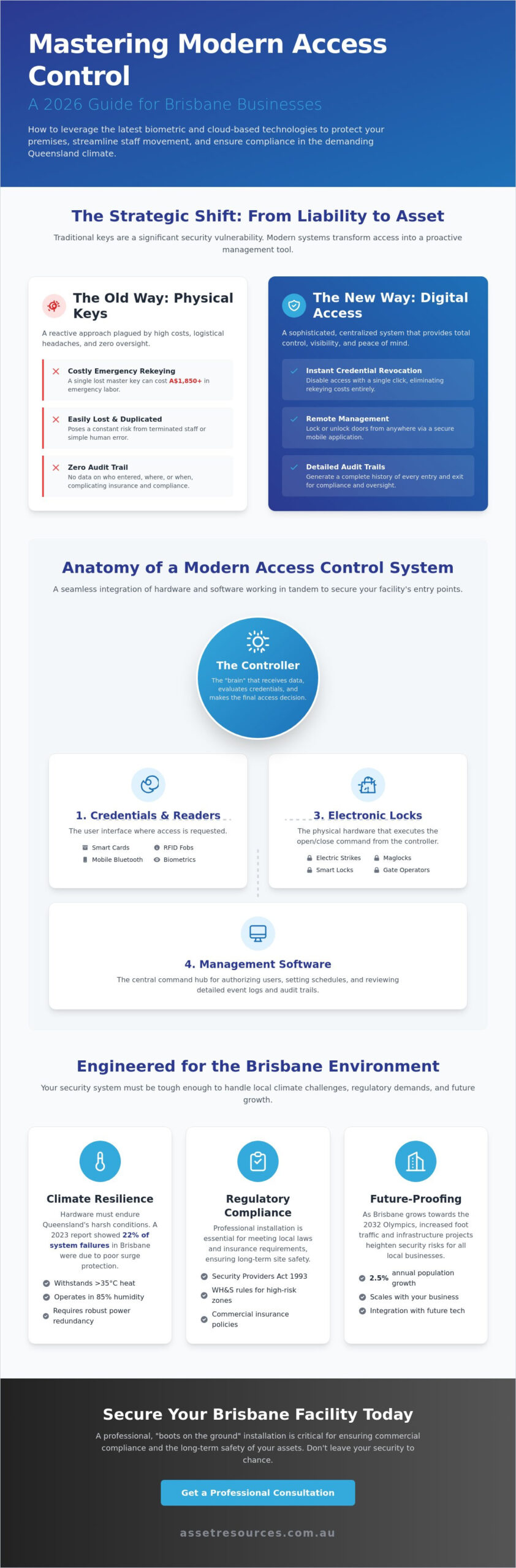
Understanding What are Access Control Systems starts with viewing security as a strategic asset rather than a basic utility. In 2026, these systems function as the digital gatekeepers of your workplace, replacing mechanical locks with sophisticated entry management hardware. As Brisbane experiences a 2.5 percent annual population growth and significant infrastructure expansion leading toward the 2032 Olympics, local businesses face higher foot traffic and increased security risks. Relying on a physical key is no longer a viable strategy for a professional operation.
Modern access control systems offer three primary advantages that old-school locks cannot match. First, they provide instant credential revocation. If a staff member leaves the company, you can disable their access with a single click rather than paying a locksmith A$300 to re-key the entire building. Second, remote management allows site managers to lock or unlock doors from any location via a secure mobile app. Finally, the system generates a detailed history of every entry and exit, providing a level of oversight that ensures operational transparency.
The Evolution of Entry Management
Physical keys represent the single largest security vulnerability for Brisbane offices. They are easily duplicated, frequently lost, and offer zero data on who used them. Digital credentials, such as encrypted mobile tokens or biometric scanners, have become the standard for 2026. This shift reduces long-term operational costs by eliminating the hardware waste associated with lost fobs and keys. From a safety perspective, these systems are essential for WH&S compliance. They allow managers to ensure only qualified personnel enter high-risk zones, such as chemical storage areas or heavy machinery floors, reducing the likelihood of workplace accidents.
Protecting Your People and Physical Assets
Your business assets include more than just equipment and inventory; they encompass your intellectual property and your workforce. Restricting access to specific zones within a facility helps mitigate the risk of internal theft, which industry reports suggest accounts for nearly 30 percent of inventory shrinkage in the Australian industrial sector. By compartmentalizing your workspace, you protect sensitive data and provide a safer environment for your team.
An Audit Trail is a chronological record of system activities that provides documentary evidence of every person who accessed a specific door at any given time. This record is a critical requirement for most commercial insurance policies in Queensland. Having a verifiable log of entries can lead to lower premiums and faster claim processing if a security breach occurs. It transforms security from a passive measure into a proactive management tool that supports both safety and financial integrity.
Core Components: How Modern Access Control Technology Works
The management software acts as the central brain. It handles the authorisation process, logging every entry and exit for audit trails. This level of oversight ensures that your people and equipment remain safe. For businesses managing complex sites, integrating these systems with reliable security infrastructure provides a clear operational advantage.
Credentials and Readers: The User Interface
Users interact with the system via credentials. RFID fobs and smart cards remain standard in many Brisbane warehouses, but mobile Bluetooth access is growing. By 2025, mobile credential adoption in Australian commercial sectors is projected to reach 45%. Mobile access removes the cost of replacing lost plastic cards, which often cost between A$5 and A$15 per unit.
- Biometrics: Facial recognition and fingerprint scanning are becoming common in high-security Brisbane facilities. These offer superior integrity because credentials cannot be shared.
- Proximity vs. Keypads: Keypad entry is a budget-friendly option, but it lacks the security of proximity-based solutions since codes are easily compromised.
- Smart Cards: Encrypted smart cards provide better protection against cloning than older 125kHz proximity cards.
Controllers and Back-End Management
The controller makes the split-second decision to grant access. It checks the user’s permissions against the database. When choosing a setup, you must decide between cloud-based and on-premise management. Cloud systems offer remote access from any device. On-premise systems provide total local control without relying on an external internet connection.
Security professionals distinguish between various types of access control systems based on how they handle communication protocols. Older access control systems use the Wiegand protocol, which is vulnerable to hacking because it transmits data in plain text. Modern SEQ installations now favour OSDP (Open Supervised Device Protocol). OSDP supports bidirectional communication and AES-128 encryption. This ensures the data moving between the reader and the controller stays private. It’s a vital technical shift for compliance in the 2026 security landscape.
The Brisbane Context: Compliance, Climate, and Integration
Operating a business in South East Queensland requires a specific approach to security infrastructure. You can’t just pick hardware off a shelf and expect it to survive the local conditions. Effective access control systems must adhere to the Security Providers Act 1993. This legislation mandates that any individual or company installing security equipment in Queensland must hold a valid Class 2 license. Engaging unlicensed contractors doesn’t just risk your site security; it can lead to heavy penalties and void your business insurance policies.
Environmental factors play a massive role in hardware longevity. Brisbane experiences average humidity levels of 65% to 70%, coupled with corrosive salt air in coastal areas like Eagle Farm or the Port of Brisbane. We select hardware with high Ingress Protection (IP) ratings, typically IP65 or higher, to prevent moisture ingress and circuit failure. Local expertise ensures your system handles these 30 plus degree days without overheating or component degradation.
Integration is where your ROI increases. Linking your entry points to a professional CCTV installation Brisbane allows for visual confirmation of every badge swipe. For companies managing multiple sites across the Gold Coast, Brisbane, and the Sunshine Coast, a unified cloud-based platform provides a single pane of glass for all asset protection.
Queensland Regulatory Standards
Compliance is non-negotiable. Under the Security Providers Act 1993, using licensed installers ensures your system meets Australian Standard AS 2201. Some commercial insurers in Australia offer premium reductions of up to 10% when you demonstrate a fully compliant, professionally maintained security perimeter. When implementing biometric access control systems, you must also comply with the Privacy Act 1988. This involves clear signage and secure, encrypted storage of sensitive data to protect your workers’ privacy rights. For a broader view of how access control fits within a complete protection strategy, the security systems Brisbane 2026 professional guide outlines how to design a compliant, integrated ecosystem that meets Queensland standards.
Integration with Alarms and Intercoms
A true security ecosystem works in sync. We configure systems so that arming the main alarm automatically deadbolts high-security zones. For facilities that want to eliminate the “cry wolf” cycle of false alerts, pairing your entry management with professional alarm systems Brisbane businesses rely on ensures verified, monitored responses that meet Queensland Police evidence requirements. Integrating a Professional Intercom Installation Brisbane allows your team to manage after-hours deliveries safely. Video verification lets staff see the courier and the manifest before remotely releasing a gate. This logic-based approach reduces human error and ensures your site remains locked down when it’s most vulnerable.
Choosing the Right System: A Practical Selection Framework
Selecting the right hardware for your Brisbane facility isn’t just a procurement task. It’s a fundamental step in securing your operational assets and ensuring the safety of your workforce. You don’t want a generic solution that leaves gaps in your perimeter or creates bottlenecks during morning shift changes. A pragmatic approach ensures your security infrastructure works as hard as your team does.
Effective deployment follows a logical, five-step sequence designed to eliminate technical debt. Start by following this framework:
- Step 1: Conduct a site-wide security risk assessment. Identify where your high-value assets sit and where unauthorized entry poses the greatest threat to safety or compliance.
- Step 2: Determine the number of controlled points. Map out every door, vehicle gate, and lift. In a typical Brisbane industrial park, this often includes perimeter fencing and internal warehouse partitions. To learn more about the types of durable materials used in secure perimeters, Romford Fencing Ltd offers a comprehensive range of professional supplies.
- Step 3: Define user groups and access levels. Your permanent staff require different permissions than a contractor on a 48-hour site induction. Clear hierarchies prevent “permission creep.”
- Step 4: Evaluate scalability. If your business plans to expand from 20 to 150 employees by 2027, your access control systems must handle the increased data load without lagging.
- Step 5: Select a local partner. Technical support from a team that can be on-site in Eagle Farm, Milton, or the Port of Brisbane within a few hours is a non-negotiable requirement for uptime.
Assessing Your Specific Site Needs
High-traffic main entries in a CBD tower might handle 1,500 movements daily, while a secure server room sees fewer than 10. You need hardware that matches these specific loads. Off-the-shelf kits often lack the relay capacity for multi-storey lift control, which is a mandatory requirement for many A-Grade commercial spaces in Queensland. Professional access control systems integrate directly with fire panels to ensure safe, automatic egress during emergencies. Statistics from 2024 industrial audits show that 85% of budget DIY kits fail to meet these specific Australian commercial compliance standards.
Future-Proofing Your Investment
Hardware longevity depends on choosing open-platform systems. This strategy prevents vendor lock-in, which can save a business up to 30% on hardware replacement costs over a ten-year cycle. By 2026, 5G and IoT integration will be the standard for real-time occupancy tracking and remote site mobilization. When you calculate the total cost of ownership (TCO), look past the initial installation fee. Factor in software licensing, cloud storage, and routine maintenance over a 5-10 year period. For businesses in southern suburbs like Inala, Acacia Ridge, and Sunnybank, pairing your entry management with a professional security camera installation Brisbane Southside solution ensures your perimeter coverage meets the 8MP 4K standard required for facial recognition and legal evidence. This ensures your security budget supports long-term growth rather than just a quick fix.
Build a more secure workplace with a team that understands Australian industrial requirements. Partner with Asset Resources for reliable security and workforce solutions.
Implementing Your System with Asset Resources Group
Asset Resources Group (ARG) brings a boots on the ground mentality to every security project across South East Queensland. We don’t believe in generic, off-the-shelf security packages that fail to account for the unique layout of a Brisbane warehouse or a high-rise corporate office. Our team views your staff and your physical property as vital business assets that require active protection. By choosing a local partner, you ensure that your access control systems are designed by professionals who understand the specific environmental and regulatory challenges of the Brisbane industrial landscape.
Professional installation is non-negotiable for commercial compliance. As of early 2026, Queensland Work Health and Safety (WHS) regulations have placed greater scrutiny on site entry management; 88% of local firms now prioritize certified installers to mitigate liability. DIY setups often fall short of Australian Standards, creating vulnerabilities in your perimeter and potential gaps in your insurance coverage. We focus on high-stakes reliability, ensuring your hardware works correctly from the first day of mobilization.
The ARG Professional Installation Process
Our mobilization process starts with a comprehensive site survey to identify high-traffic zones and potential breach points. We prioritize a safety-first approach, meaning our technicians coordinate hardware mounting and wiring to avoid any interference with your daily operations. Once the physical components are live, we provide hands-on staff training. This ensures your team feels confident using the software, turning a complex technical transition into a streamlined operational win. We stay on-site until the handover is 100% complete.
Next Steps for Brisbane Businesses
Maintaining a secure site is an ongoing commitment, not a one-time event. ARG provides 24/7 support and scheduled maintenance to ensure your access control systems remain resilient against evolving threats. Since 2024, South East Queensland has seen a 15% increase in demand for integrated security audits. We recommend starting with a tailored assessment of your current entry points to identify where your protection might be lagging behind 2026 standards.
To see how your current setup measures up against industry benchmarks, you can review our Business Security Solutions in Brisbane guide. This resource helps you compare different protection tiers to find the right fit for your budget and risk profile. Don’t leave your site’s integrity to chance. Contact Asset Resources Group today to secure your assets with a partner that values hard work, local expertise, and absolute reliability.
Future-Proof Your Brisbane Business Entry Strategy
Managing site access isn’t just about locking doors; it’s about building a resilient operational framework for the years ahead. By 2026, leading Brisbane firms will rely on access control systems that integrate seamlessly with CCTV and alarm hardware to meet mandatory QLD security compliance standards. You now understand how modern technology handles the unique Queensland climate while protecting your physical and digital assets. Effective security requires a practical, “boots on the ground” approach that balances high-tech features with everyday usability for your staff and contractors.
Asset Resources Group brings specialized expertise to the Brisbane commercial and industrial sectors. As a Licensed QLD Security Provider, we don’t just sell equipment; we deliver integrated solutions that include CCTV and alarm systems tailored to your specific site needs. We’ve helped local businesses transition from legacy setups to sophisticated, audit-ready entry management. For facility managers looking to understand how access control fits within a complete protection framework, our security systems Brisbane professional guide covers the full spectrum of intruder alarms, CCTV, and weather-resistant hardware designed for Queensland conditions. It’s time to ensure your facility is as secure as it is efficient.
Contact Asset Resources Group for a Professional Brisbane Access Control Audit to start your security upgrade. Our team is ready to help you build a safer, more reliable workplace today.
Frequently Asked Questions
How much does a commercial access control system cost in Brisbane?
A basic single-door setup in the Brisbane market typically starts between A$1,500 and A$2,500 for hardware and professional installation. Costs scale based on the number of entry points and the complexity of the mobilization required for your specific site. Enterprise-grade solutions for large industrial hubs involve higher upfront investments but offer lower long-term management costs through centralized software.
Can I integrate my existing security cameras with a new access control system?
Most modern systems integrate directly with existing IP-based CCTV cameras using the ONVIF protocol or dedicated software APIs. This connection allows your team to link specific door events with time-stamped video footage for better visual verification. It’s a practical way to boost site integrity without replacing your entire security infrastructure at once.
What happens to the electronic locks if the power goes out at my Brisbane office?
Your locks will behave based on whether they’re configured as fail-safe or fail-secure. Fail-safe locks release automatically during a power cut to allow safe exit, while fail-secure locks stay bolted to maintain perimeter security. We install 12V or 24V battery backups in most Brisbane systems to provide 4 to 8 hours of continued operation during local grid failures.
Do I need a special license to install access control in Queensland?
Yes, all individuals and companies installing security equipment in Queensland must hold a valid Security Provider License (Class 2) issued by the Office of Fair Trading. This requirement is mandated under the Security Providers Act 1993 to ensure technical competence and safety. Hiring unlicensed contractors can lead to fines exceeding A$10,000 and might void your business insurance policy.
What is the difference between a cloud-based and a local server access system?
Cloud-based systems host your data on remote servers, which lets you manage staff permissions from any smartphone or laptop. Local systems rely on a physical server located on your premises, providing total data sovereignty but requiring more hands-on maintenance. Roughly 75% of new commercial installations in 2025 utilize cloud technology for its flexibility and lower upfront hardware requirements.
How many users can a standard business access control system handle?
Standard commercial controllers usually support between 1,000 and 5,000 unique users right out of the box. For larger operations like mining camps or multi-storey corporate offices, enterprise systems can manage over 100,000 individual credentials across multiple sites. You don’t need to replace the whole system to grow; you simply add more door controllers as your workforce expands.
Can I use my mobile phone instead of a swipe card for entry?
You can use mobile credentials via Bluetooth or NFC technology to turn smartphones into secure digital keys. This eliminates the ongoing cost of purchasing plastic swipe cards and reduces the security risk of lost physical assets. It’s a reliable, “boots on the ground” solution that aligns with the digital habits of a modern Australian workforce.
How often should an access control system be serviced in the QLD climate?
Professional servicing should occur every 6 to 12 months to account for Queensland’s high humidity and coastal salt air. Heat and moisture can cause electronic components to degrade or backup batteries to swell prematurely. Regular preventative maintenance ensures your access control systems function correctly during emergencies and remain compliant with workplace safety standards.