A single unauthorized flight over a Brisbane construction site can trigger CASA fines exceeding A$15,000 for a corporate entity in 2026. You already understand that aerial surveillance is a practical, boots on the ground solution for site safety and asset protection across South East Queensland. However, the technical legalities often feel designed to stall your progress rather than support it. It’s a common headache to manage the fine line between recreational use and commercial “excluded” categories when you just need to secure your perimeter and protect your high-value equipment.
This guide ensures your local operations stay 100% compliant with the latest casa drone rules without compromising on project momentum. We’ve built this resource to help you master the complex landscape of aerial security in industrial zones. You will find a clear checklist for legal operations, a breakdown of the restricted airspace surrounding Brisbane Airport and Archerfield, and the data you need to decide between DIY flights and hiring a professional. We’re focused on providing the clarity you need to keep your assets safe and your liability low.
Key Takeaways
- Master the Standard Operating Conditions (SOCs) to ensure your Brisbane drone operations remain grounded in safety and strict regulatory compliance.
- Identify how to leverage the “Excluded Category” for drones under 2kg to streamline your commercial asset inspections without unnecessary operational delays.
- Navigate Brisbane’s complex restricted airspace with confidence by understanding the casa drone rules surrounding airport exclusion zones and mandatory radio monitoring.
- Mitigate legal liability by aligning your aerial surveillance practices with the Privacy Act 1988 and implementing robust industrial data management protocols.
- Discover the strategic advantages of integrating professional UAV data with your existing site security systems for a total, “boots on the ground” protection solution.
Understanding the 2026 CASA Drone Rules: The Standard Operating Conditions
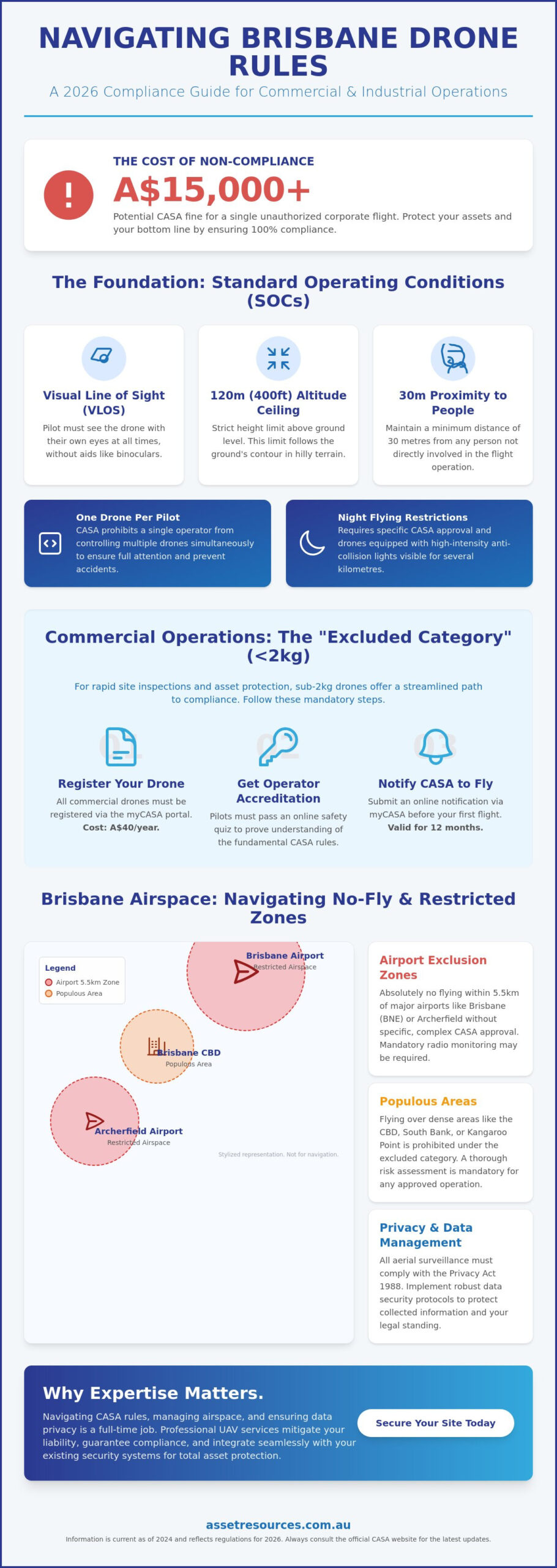
The Standard Operating Conditions (SOCs) represent the mandatory safety framework for all Remotely Piloted Aircraft (RPA) operations across the country. For project managers in the mining and civil sectors, these casa drone rules are the foundation of site safety and legal compliance. The most critical requirement is maintaining Visual Line of Sight (VLOS). This means the pilot must be able to see the aircraft with their own eyes without using binoculars or telescopes. While International Drone Regulations often provide different height tiers, Australia enforces a strict 120-metre (400-foot) ceiling above ground level. Additionally, you must keep the drone at least 30 metres away from people not directly involved in your flight mission. This buffer protects the public and shields your business from costly litigation.
The “One Drone per Pilot” Rule and Night Flying
CASA doesn’t allow a single operator to command multiple drones at once for professional asset protection. This rule exists because split attention leads to accidents on high-stakes industrial sites. Night flying in Brisbane requires specific equipment, such as high-intensity anti-collision lights visible for several kilometres. If you’re operating near Brisbane’s hilly terrain, such as the ridges around Mount Coot-tha or the steep streets of Paddington, the 120-metre limit follows the ground’s contour. You can’t just set a fixed altitude. You must actively manage the ceiling as the elevation changes beneath the drone to stay within the legal 2026 limits.
Flying Over Populous Areas
A populous area is any location where a drone failure could pose a risk to people. In a dense urban environment like the Brisbane CBD or the Kangaroo Point cliffs, the margin for error is zero. CASA expects professional operators to conduct a thorough risk assessment before any mobilization near these zones. If you’re flying near South Bank, your flight plan must account for wind gusts between buildings and the density of pedestrians. It’s about practical safety management. You don’t take risks with people’s lives or your project’s standing. Following these protocols ensures your asset protection strategy is both effective and fully compliant with the latest casa drone rules. This “safety-first” approach is what separates professional industrial pilots from hobbyists.
Commercial vs. Recreational: Navigating the “Excluded Category”
In 2026, the line between flying for fun and flying for profit is crystal clear. If you use a drone to support any business activity, even if money doesn’t change hands directly, you must follow specific CASA drone safety rules. Hobbyists fly for pure recreation. Commercial pilots, however, fall into different regulatory tiers based on the risk and weight of the aircraft. For many Brisbane firms, this starts with the “excluded category,” which allows for lower-risk operations without a full pilot license under strict conditions.
Compliance isn’t optional. Every drone used for business, regardless of size, must be registered via the myCASA portal. As of the latest fee schedules, commercial registration for a drone costs A$40 per year. Additionally, pilots operating in the excluded category must pass a mandatory online safety quiz to obtain an Operator Accreditation. This accreditation proves you understand the basic laws before launching over a commercial worksite. It’s a foundational requirement that ensures everyone in the Brisbane airspace stays safe.
Micro and Very Small RPA (Under 2kg)
Brisbane’s industrial sectors often utilize sub-2kg unmanned aerial vehicle (UAV) technology for rapid stockpile measurements or basic site inspections. While these drones are smaller, they aren’t exempt from casa drone rules. You can’t fly them over people or within 30 meters of others. You’re also barred from flying in restricted airspace, which is common around Brisbane Airport and the CBD. Before your first flight, you must notify CASA via myCASA of your intent to fly in the excluded category. This notification is valid for 12 months and must be renewed annually.
When You Need a ReOC and RePL
For high-stakes asset protection, the excluded category often falls short of operational needs. You need to understand the difference between the two main certifications:
- Remote Pilot Licence (RePL): This is an individual qualification, similar to a driver’s license, showing a pilot is competent to fly.
- Remote Operator’s Certificate (ReOC): This is the business-level certification that allows a company to operate as an aviation entity.
If you’re operating drones over 2kg or need to fly outside standard operating conditions, a ReOC is mandatory. Using an uncertified employee for a commercial survey creates massive legal liability. If an accident occurs, insurance typically won’t cover a pilot who lacks the proper CASA credentials. Professional teams provide the safety-first approach required for complex mining and civil projects. Partnering with a specialist workforce solution ensures your project remains compliant and productive while managing these technical risks.
Brisbane No-Fly Zones: Navigating Restricted Airspace
Brisbane’s airspace is among the most tightly managed in Australia. Operating a drone here requires more than just a steady hand; it demands a deep understanding of the CASA drone safety rules that govern our skies. With Brisbane Airport (BNE) to the northeast and Archerfield Airport to the south, much of the metropolitan area sits within controlled airspace. Staying compliant with casa drone rules is essential for maintaining your operator accreditation and ensuring project safety.
The 5.5km rule is a critical threshold for every professional operator. If you’re flying a drone for work within 5.5km of a controlled aerodrome, you must not create a hazard to manned aircraft. Professionals often need to monitor VHF radio frequencies to maintain situational awareness of local traffic. Certain zones, such as the Port of Brisbane and various government facilities, remain strictly off-limits due to national security and high-risk operational environments. Before every mobilization, pilots must use CASA-verified drone safety apps to check local flight conditions in real-time.
The Inner-City Challenge: Flying Near BNE and CBD
Brisbane’s parallel runway system creates specific flight paths that drones must avoid to prevent catastrophic mid-air collisions. The CBD is particularly challenging because of its proximity to major medical hubs. Helicopter landing sites (HLS) at the Royal Brisbane and Women’s Hospital (RBWH) and the Princess Alexandra (PA) Hospital create temporary no-fly zones whenever emergency services are active. Archerfield’s class D airspace extends significantly into Brisbane’s southern industrial suburbs, requiring strict compliance from operators in those industrial zones.
Council By-Laws and Local Land Use
Don’t confuse CASA airspace permissions with land-use rights. While CASA controls the air, the Brisbane City Council (BCC) regulates the ground. You need specific permits to launch or land a drone from public parks or Brisbane River walkways. For teams conducting drone surveying in sensitive zones, coordination with local authorities is mandatory. This double layer of regulation ensures that industrial projects proceed without legal friction. Successful asset protection relies on this “safety-first” approach to mobilization.
- Check the App: Always verify the current airspace status via a CASA-approved provider.
- Radio Monitoring: Maintain a listening watch if operating near Archerfield or BNE.
- Permit Check: Confirm BCC land-access permits are secured 14 days in advance.
Operational Compliance for Industrial Asset Protection
Operational compliance in Brisbane isn’t just about keeping a drone in the air; it’s about managing legal liability on the ground. When you integrate aerial tech into your asset protection strategy, you’re immediately subject to the Privacy Act 1988. This federal legislation dictates how industrial operators collect and store “identifiable” information. For a project manager at the Port of Brisbane or a site supervisor in the Bowen Basin, this means aerial footage showing faces or license plates must be handled with the same rigor as personnel files. You’ve got to ensure your data management plan uses encrypted storage, as 62% of industrial data breaches in 2024 stemmed from unsecured mobile devices and cloud backups.
Queensland operators face additional layers via the Surveillance Devices Act 1971 (QLD). This law prohibits using “optical surveillance devices” to record private activities without consent. However, there’s a clear legal distinction between surveillance and a maintenance inspection. If your flight path is documented in a Standard Operating Procedure (SOP) as a structural integrity check of a refinery stack, it’s categorized as maintenance. Adhering to casa drone rules ensures you stay within the “excluded” or “licensed” category, but your SOP must explicitly state the purpose of every flight to protect the business from litigation.
Privacy and Trespass Concerns
Flying over neighboring Brisbane properties can lead to “nuisance” or “trespass” claims if not managed correctly. While CASA controls the airspace, property owners still have rights to the “reasonable enjoyment” of their land. Best practice for industrial sites involves providing 48 hours’ notice to adjacent businesses before a scheduled inspection. This simple step reduces the risk of stop-work orders by 45%. Always keep your camera tilted toward the asset you’re inspecting to avoid capturing neighboring yards or private offices, which prevents common law privacy disputes.
Incident Reporting and Insurance
If an accident occurs, the Transport Safety Investigation Act 2003 mandates reporting “serious incidents” to the Australian Transport Safety Bureau (ATSB) and CASA. This isn’t optional. You must maintain digital flight logs and maintenance records for at least seven years to satisfy audit requirements. Most standard business insurance policies don’t cover aviation risks. You’ll need specialized UAV Public Liability Insurance, typically with a minimum coverage of A$10 million to A$20 million for industrial sites. Without this specific policy, a single equipment failure could result in a total loss of the asset and a massive liability hit to your balance sheet.
Ensure your workforce is backed by a team that understands the complexities of industrial compliance and safety-first mobilization.
Partner with Asset Resources for compliant workforce solutions
Professional UAV Services: Why Expertise Matters in Brisbane
Managing the complex skies over a high-value industrial site in Brisbane involves more than just a steady hand on the controller. It requires a strict adherence to casa drone rules, especially given the city’s proximity to major flight paths and controlled zones. For project managers in the mining and construction sectors, professional drone hire is the most efficient way to secure a site while staying compliant. Professional pilots bring the technical skill to manage CASA waivers for restricted zones near Brisbane Airport or the Port of Brisbane, where unauthorized flights can lead to fines exceeding A$15,000.
Integrating aerial data with your existing security infrastructure creates a formidable defense. While traditional CCTV provides a fixed perspective, UAVs offer a dynamic layer of intelligence that fills the gaps. Linking drone feeds directly into your site’s access control system allows for rapid response to perimeter breaches. This safety-first approach ensures that your physical security and digital data work in tandem to protect your assets. The ROI of hiring an expert becomes clear when you compare the cost of a professional survey to the massive financial and reputational damage of regulatory non-compliance.
- Regulatory Peace of Mind: Expert pilots handle all flight notifications and risk assessments required by CASA.
- Operational Efficiency: Aerial surveys reduce the need for manual inspections by 65%, keeping staff out of high-risk areas.
- Total Site Visibility: Combining ground-level sensors with aerial views eliminates blind spots in large industrial yards.
Advanced Technology: Beyond the Basic Camera
Consumer drones often fall short for industrial-grade inspections. Professional UAV services utilize Thermal imaging and LiDAR to detect structural weaknesses or heat signatures that the naked eye misses. In a 2025 project, ARG integrated aerial intelligence with physical security hardware for a Brisbane logistics hub. This mobilization of high-tech sensors reduced unidentified site entries by 42% within the first three months. Using professional-grade hardware ensures the data you receive is actionable, not just aesthetic.
Securing Your Brisbane Assets Today
If you require an immediate aerial survey for a Brisbane industrial site, the process starts with a thorough security audit. ARG provides tailored solutions that align with the specific casa drone rules governing your location. We don’t just fly drones; we provide a partnership that prioritizes the integrity of your workforce and your equipment. Our team manages the mobilization of equipment and personnel so you can focus on project delivery. Contact Asset Resources Group for professional drone asset protection today.
Future-Proofing Your Industrial Security Strategy
Brisbane’s industrial landscape moves fast. By 2026, the growing complexity of casa drone rules means that simple recreational flying won’t cut it for high-stakes asset protection. We’ve seen how navigating restricted airspace near the Brisbane Airport and the Port of Brisbane requires more than just a basic license. It demands a safety-first approach to surveillance that integrates high-spec hardware with professional oversight. Companies across South East Queensland are moving away from the “excluded category” to ensure full operational compliance on civil and mining sites.
Asset Resources Group (ARG) delivers the “boots on the ground” expertise needed to manage these aerial risks. We provide CASA-compliant operation protocols and integrated aerial surveillance solutions tailored for the Queensland market. Our team operates as specialists in South East Queensland industrial security, ensuring your project remains safe and compliant without the headache of managing complex UAV regulations yourself. Don’t let compliance gaps compromise your site’s safety or your company’s reputation.
Secure your Brisbane assets with professional UAV services from ARG
It’s time to elevate your security standards and keep your operations moving forward with confidence.
Frequently Asked Questions
Do I need a license to fly a drone for my Brisbane business?
You need a Remote Pilot Licence (RePL) if you intend to operate drones commercially outside the “excluded” category. For Brisbane businesses monitoring industrial assets, holding a RePL ensures full compliance with casa drone rules. While you can fly a drone under 2kg without a license by notifying CASA, professional site mobilization usually requires the higher-tier ReOC to manage safety risks effectively on complex civil projects.
Can I fly a drone in my own backyard in Brisbane?
You can fly in your backyard provided you follow standard operating conditions, including staying 30 metres away from other people. However, 45 percent of Brisbane residential zones fall within controlled airspace or near airfields like Archerfield. If you’re within 5.5 kilometres of a controlled aerodrome, you can’t fly higher than the surrounding trees or buildings. Safety remains the priority even on private property.
What happens if I break CASA drone rules in Queensland?
Breaking casa drone rules results in immediate financial penalties and potential legal action. CASA issues on-the-spot fines of A$1,565 for individual breaches, while serious safety violations prosecuted in court can reach A$15,650. For Queensland industrial firms, these breaches also jeopardize your corporate reputation and insurance coverage. Maintaining a clean compliance record is essential for long-term project viability and workforce safety.
How close can I fly a drone to a building or structure?
You must maintain a horizontal distance of 30 metres from people who aren’t directly involved in the drone’s operation. While there isn’t a specific minimum distance from inanimate structures, professional operators typically maintain a 5 to 10 metre safety buffer to prevent collisions. For asset protection tasks, ensure your flight path doesn’t create a hazard to the public or property below the 120 metre altitude limit.
Do I need to register my drone if it weighs less than 250g?
You must register any drone used for business purposes regardless of its weight. Even a 249g micro-drone requires registration with CASA if it’s utilized for commercial site inspections or labor hire monitoring. Registration costs A$40 annually for commercial operators as of 2024. Failing to register your equipment before mobilization can lead to project delays and fines from regulatory authorities.
Are there specific drone rules for flying near the Port of Brisbane?
The Port of Brisbane is a sensitive industrial zone that requires strict adherence to maritime and aviation security protocols. Because the port sits under the flight paths for Brisbane Airport, you must check for active Restricted Areas which cover 100 percent of the terminal zones. Always coordinate with port authorities and use a CASA-verified app to confirm current airspace status before launching any surveillance or mapping flights.
How do I check if my Brisbane site is in a no-fly zone?
Use a CASA-verified drone safety app like OpenSky or AirMap to check your specific GPS coordinates. These platforms provide real-time data on 15 different types of restricted airspace across the Brisbane metropolitan area. Checking the map is a mandatory step in your pre-flight safety checklist. It ensures your team avoids the 5.5 kilometre exclusion zones surrounding major hospitals with helipads and military installations.
Can I fly a drone over a crowded event in Brisbane?
You cannot fly a drone over a populous area or a crowded event like the Brisbane Festival or sporting matches. CASA defines a populous area as any space where a drone failure could pose a risk to people below. To fly in these locations, you must apply for a specific Part 101 permit, which requires a detailed risk assessment and a 28 day processing window. Safety-first operations prevent accidents in high-density corporate environments.