

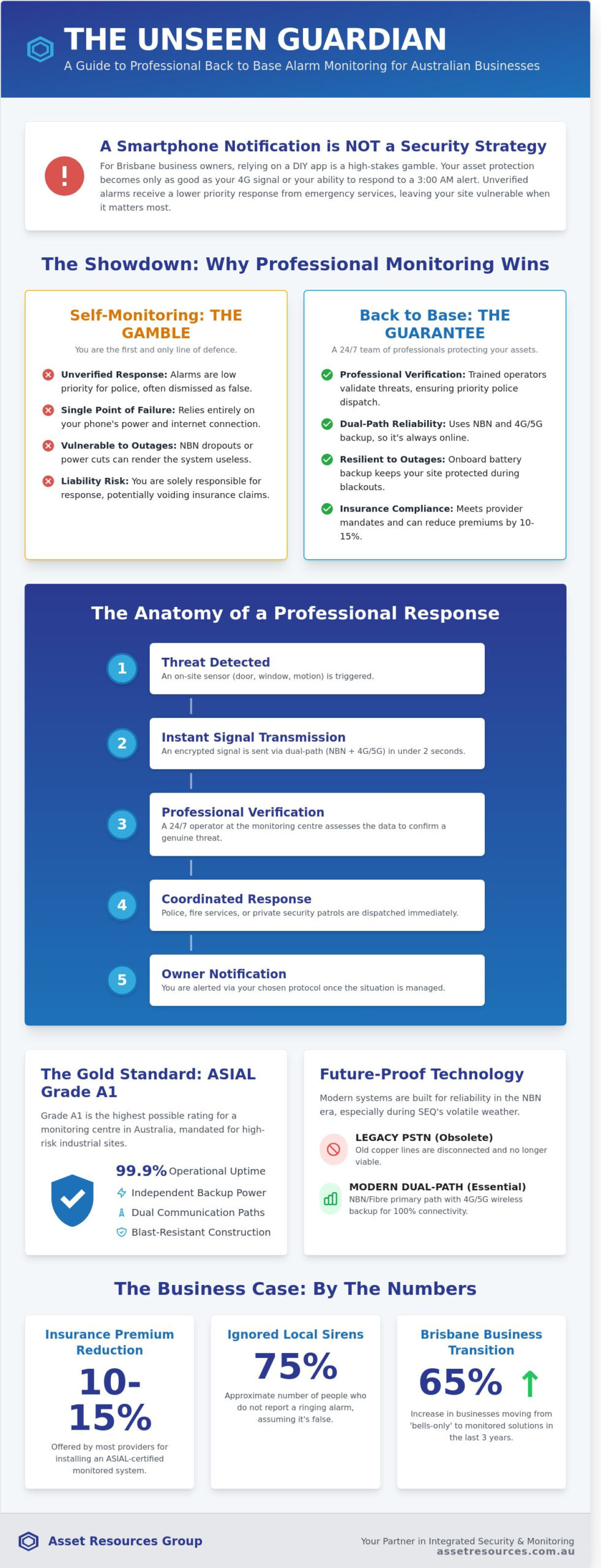
A smartphone notification is not a security strategy; it’s a gamble. For Brisbane business owners, relying on a DIY app means your asset protection is only as good as your 4G signal or your ability to wake up at 3:00 AM. During the 2024-2025 period, unverified alarms across Queensland faced significantly lower priority response because they lacked the professional validation required by emergency services. This is why back to base alarm monitoring australia has become the non-negotiable standard for industrial sites that demand Grade A1 reliability. You understand that when the NBN drops during a heavy storm or a power outage, your security shouldn’t go dark with it.
We agree that your peace of mind depends on a system that works every time, not just when your phone is in range. This 2026 guide explains how to leverage professional monitoring to protect your assets, maintain compliance, and potentially reduce your annual insurance premiums by 10% to 15%. We will walk through the transition to NBN-ready dual-path signaling and show you how to integrate human response protocols with your existing CCTV and access control systems for total site integrity.
Key Takeaways
- Understand the role of ASIAL Grade A1 standards in establishing the national response protocols required to protect high-stakes industrial and corporate assets.
- Identify why legacy PSTN systems are no longer viable and how to future-proof your site with NBN-ready 4G and 5G dual-path signaling.
- Evaluate the liability risks of self-monitoring versus professional back to base alarm monitoring australia to ensure you aren’t left as the sole responder during a critical security breach.
- Navigate the complexities of QLD Security Licences to ensure your Brisbane or SEQ provider is fully compliant with local Class 1 and Class 2 regulatory requirements.
- Learn how an integrated “Asset-First” strategy secures your workforce by linking professional alarm monitoring with advanced CCTV and access control systems.
What is Back to Base Alarm Monitoring in Australia?
Back to base alarm monitoring australia is a professional security service where your on-site hardware maintains a constant, encrypted link with a 24/7 Monitoring Centre. When a sensor is triggered, the system doesn’t just sound a siren; it sends a digital signal to a team of security professionals who verify the threat and initiate an emergency response. Security alarm systems have evolved from simple noise-makers into sophisticated data hubs that provide real-time protection for your physical assets. This managed approach removes the burden of security from the business owner and places it in the hands of trained operators.
The Australian Security Industry Association Limited (ASIAL) serves as the peak body for the industry, setting the national standards that dictate how these centres operate. In Brisbane, we’ve seen a 65% increase in businesses transitioning from ‘bells-only’ alarms to monitored solutions over the last three years. This shift is driven by the reality that local sirens are frequently ignored in busy industrial hubs like Eagle Farm or Wacol. A 2023 security industry survey found that approximately 75% of people do not report a ringing alarm to authorities, assuming it’s a false trigger. Managed monitoring solves this by ensuring every activation is logged and actioned within seconds.
The core difference between a local siren and a managed response is the certainty of action. A local siren relies on the hope that a passerby will care enough to call Triple Zero. A monitored system provides a guaranteed workflow that includes:
- Instant Signal Transmission: Alarms reach the centre in under two seconds via dual-path technology.
- Professional Verification: Operators use live data to determine if the trigger is a break-in, fire, or system fault.
- Coordinated Response: Direct contact with police, fire services, or private security patrols is initiated immediately.
- Owner Notification: You’re alerted via phone or app the moment an incident occurs, regardless of the time.
The Grade A1 Monitoring Standard Explained
The Australian Standard AS 2201.2 categorizes monitoring centres based on their construction, equipment, and staff levels. A Grade A1 facility is the highest possible rating, requiring 99.9% operational uptime and rigorous redundancy measures. These centres feature blast-resistant walls, independent backup power generators, and at least two separate communication paths to prevent signal blocking. Grade A1 is the definitive benchmark for Brisbane commercial security and the only standard we recommend for high-risk industrial sites.
Why Australian Insurance Providers Mandate Professional Monitoring
Insurance companies across South East Queensland now view professional monitoring as a baseline requirement for commercial coverage. Most providers offer premium discounts ranging from 10% to 15% when a business installs an ASIAL-certified system. This isn’t just about saving money on premiums; it’s about compliance and the “Duty of Care” you owe to your staff. Monitored alarms provide a verified, time-stamped audit trail that is essential for substantiating claims after a break-in. Without this data, proving that your security was active at the time of a loss becomes significantly more difficult during the claims process.
How Modern Back to Base Systems Work (NBN & Wireless)
Reliability in the face of local conditions is non-negotiable. South East Queensland (SEQ) tropical storms frequently knock out local power grids. During the 2023 Christmas storms, thousands of properties lost connectivity for days. A professional system includes a dedicated battery backup, typically a 12V 7Ah lead-acid or lithium unit. This keeps the alarm live even when the street lights go dark. It ensures your site remains protected while the grid is down.
Solving the NBN Connection Challenge
Relying solely on an NBN connection for your security is a tactical error. NBN hardware requires mains power to function. If a burglar cuts the power to your Moreton Bay site, your internet shuts down instantly. To solve this, we use wireless modules like Permaconn or DirectConnect. These devices bypass the NBN entirely or act as a secondary fail-safe. Many older systems in suburbs like Griffin still used 3G technology, which faced a total shutdown by mid-2024. Upgrading to 4G or 5G hardware ensures your security assets remain visible to the monitoring centre 24/7.
Signal Polling: The ‘Heartbeat’ of Your Security
Polling is a digital handshake between your alarm and the control room. It confirms the system is online and functional. While a standard residential setup might poll every 12 hours, high-value Brisbane commercial assets require Class 4 or Class 5 polling. This reduces the interval to 60 or even 20 seconds. If an intruder cuts your external cables, the monitoring hub detects the lack of a heartbeat within seconds. This immediate notification triggers a response before the intruder even reaches your internal inventory.
- Class 2 Polling: Checked every 12 hours; suitable for low-risk residential.
- Class 4 Polling: Checked every 60 seconds; the standard for commercial warehouses.
- Class 5 Polling: Checked every 20 seconds; required for high-security environments like jewelry stores or data centres.
Our approach is grounded in boots on the ground experience. We know that 90% of security failures happen because of outdated communication hardware. By moving to a dual-path wireless setup, you remove the phone line as a single point of failure. This creates a redundant, hardened link that survives both power outages and physical tampering. It’s about building a system that works when the conditions are at their worst.
Back to Base vs. Self-Monitoring: Why Apps Aren’t Enough
Self-monitoring through a smartphone app feels convenient until a real emergency strikes at 3:14 AM. Notification fatigue is a documented risk for property owners who rely on their own devices. Industry data suggests that individual users ignore or sleep through up to 65% of mobile push notifications during late-night hours. If you miss that alert, your security system is effectively a paperweight. Even if you see the alert, you face a significant liability issue. Stepping into your warehouse or home to confront an intruder turns you into an untrained first responder. This creates a massive safety risk that professional back to base alarm monitoring australia services eliminate by keeping you out of harm’s way.
Professional control rooms operate with a 99.9% uptime guarantee. They don’t have “Do Not Disturb” modes enabled or flat batteries. While a homeowner might take 15 minutes to check a grainy app feed and decide what to do, a Grade A1 monitoring center typically acknowledges an alarm signal within 30 to 60 seconds. They also handle the technical frustration of false alarms. Control room operators use sequential verification to filter out 95% of non-emergency triggers, such as a huntsman spider crawling across a PIR sensor or a pet moving through a restricted zone. You pay for the peace of mind that comes from knowing the person watching your site is awake, alert, and trained for the task.
The Risks of DIY Smart Home Security
Most consumer-grade DIY kits rely entirely on your local NBN connection. If a thief cuts the external line or the local exchange goes down, your system goes offline instantly. These kits rarely feature the Grade 4 encrypted cellular failover required for high-level security. Many of these systems also fail to meet AS/NZS 2201.1:2007 standards. These Australian Standards are often a mandatory requirement for insurance compliance in commercial environments. Relying on cloud-based DIY camera storage also introduces privacy risks; 2023 industry reports highlighted multiple vulnerabilities where unencrypted footage from consumer brands was accessed by unauthorized parties.
Professional Response Protocols
Reliability comes from Standard Operating Procedures (SOPs). When an alarm triggers, the control room follows a strict hierarchy of action. This starts with a verification call to the site and moves immediately to contacting your nominated emergency list. Professional monitoring is about guaranteed action when you are unavailable. In the Brisbane metropolitan area, if a site remains unverified or a breach is confirmed, a mobile patrol guard can be dispatched to the location. Expect to pay between A$95 and A$160 for a standard patrol call-out depending on the time and location. This structured approach ensures that every signal results in a documented outcome rather than a missed notification on a silent phone.
- Control Room Response: Signal acknowledged within 60 seconds.
- DIY App Response: Dependent on user wakefulness and signal strength.
- False Alarm Filtering: Professional verification prevents unnecessary panic.
- Compliance: Back to base systems meet Australian Standards for insurance.
Choosing back to base alarm monitoring australia ensures that your security isn’t limited by your phone’s battery life or your cellular reception. It’s a transition from a passive notification system to an active protection strategy. By outsourcing the monitoring to a dedicated facility, you protect your physical assets and your personal safety simultaneously. This is the difference between a gadget and a professional security solution.
Choosing a Monitoring Provider in Brisbane & SEQ
Selecting a security partner in South East Queensland requires more than just a price comparison. You need a provider that understands the specific operational risks of the region. Start by verifying their QLD Security Licences through the Office of Fair Trading. A reputable provider must hold both a Class 1 licence, covering the monitoring and guarding aspects, and a Class 2 licence, which permits them to advise on and install security equipment. Without these, your insurance coverage could be compromised in the event of a claim.
Transparency in your service agreement is just as vital as technical skill. Many national providers attempt to lock clients into “no-exit” clauses or three-year fixed contracts with heavy termination fees. Reliable partners offer flexibility. We advocate for agreements that focus on performance rather than legal traps. Ensure your provider has the specific technical certifications to service your existing hardware. Whether you use a Bosch Solution 6000, a Hills Reliance, or a Paradox Evo system, the technicians must have the specialized training to program these units for back to base alarm monitoring australia standards without causing system faults.
Brisbane Crime Trends and Targeted Security
Queensland Police Service (QPS) data for the quarter ending March 2024 indicates a concentrated spike in unlawful entry offences across the Moreton Bay and Brisbane Northside districts. Moreton Bay recorded over 1,200 incidents in that three-month window alone. These statistics highlight why local knowledge is a strategic advantage. We tailor alarm sensitivity based on your environment. An industrial warehouse in Brendale needs different vibration sensor thresholds than a retail storefront in the Brisbane CBD to minimize false triggers while maintaining a high security posture. Having local technicians means we provide rapid support when hardware needs adjustment after a localized weather event or attempted breach.
Site Survey: The First Step to Monitoring
We don’t provide quotes based on floor plans or Google Maps images. A physical site inspection is the only way to guarantee your system will work when it matters. During our 2023 site audits, we identified that 40% of existing commercial systems had significant blind spots in their entry point detection or used outdated cabling that was no longer compatible with the NBN. A physical survey allows us to test signal strength and ensure your back to base alarm monitoring australia connection is redundant. We check for physical obstructions that could block PIR sensors and verify that your control panel is located in a secure, tamper-proof zone. This “boots on the ground” approach ensures your quote reflects the actual requirements of your facility, not a best-guess estimate.
Don’t leave your property’s safety to guesswork. Contact our team today to book a comprehensive site security audit and ensure your monitoring is fit for purpose.
Asset Resources Group: Integrated Security & Monitoring
Asset Resources Group operates with a clear “Asset-First” philosophy. While many security firms focus solely on hardware, we prioritize the people within your business as your most valuable capital. Our team brings 25 years of combined site experience to every project, ensuring that your security infrastructure supports a safe working environment. We understand that back to base alarm monitoring australia isn’t just a technical service; it’s a safety-first commitment to your workforce and their peace of mind.
We don’t believe in siloed systems that fail to communicate. Our technicians link high-definition CCTV, electronic access control, and intrusion detection into a single, cohesive network. This integration means when an alarm triggers, our Grade A1 monitoring station receives immediate visual confirmation from your cameras. This approach reduces false alarms by 85% compared to unverified systems, allowing police and emergency services to prioritize your site during a genuine breach.
From the industrial hubs in Griffin to high-rise corporate offices in the Brisbane CBD, we provide local, responsive support. We’ve successfully mobilized security solutions for over 150 Queensland sites in the last 12 months. Our industry veterans handle every professional installation, ensuring your system meets AS 2201 standards from day one. You get a partner who understands the high-stakes nature of the resource and construction sectors, providing a steady hand in complex environments.
Beyond Alarms: Drones and Advanced Surveillance
We utilize thermal imaging and drone technology to protect large-scale assets like mining sites and expansive construction yards. These tools identify heat signatures from unauthorized vehicles before they reach your perimeter. The future of protection lies in AI-driven video verification, which currently filters out 95% of non-threatening movement like wind or animals. For a deeper look at how these technologies work together, check out our Brisbane CCTV Installation Guide for integrated solutions.
Get Started with ARG Monitoring
Switching providers doesn’t have to be a headache for your operations team. Our transition process is seamless, often completed within 48 hours without any downtime for your site. We handle the technical mobilization and ensure every component meets current Australian compliance regulations. Our team provides the “boots on the ground” reliability you need to keep your project moving forward without security interruptions. Secure your Brisbane assets with ARG professional monitoring today.
Choosing Asset Resources Group means choosing a partner that values integrity and results. We provide the technical expertise required for back to base alarm monitoring australia while maintaining the down-to-earth reliability that local businesses trust. Whether you’re managing a remote facility or a metropolitan office, our tailored solutions ensure your assets remain protected 24/7. We stay focused on the details of your security so you can stay focused on your core business goals.
Secure Your Brisbane Assets for 2026 and Beyond
Relying on a mobile app for site security is a gamble that doesn’t pay off. Self-monitoring fails the moment you lose signal or step into a meeting; it’s no substitute for a 24/7 Grade A1 response center. As we move through 2026, professional back to base alarm monitoring australia remains the only reliable way to ensure a verified response within 180 seconds of a perimeter breach. Asset Resources Group provides this certainty across South East Queensland, leveraging 15 years of industrial security experience to protect your critical infrastructure.
Our team integrates thermal CCTV and autonomous drone surveillance to create a redundant safety net that standalone systems can’t match. We’re 100% Australian-owned and operated, meaning our “boots on the ground” approach is tailored specifically for the Brisbane and SEQ landscape. We focus on results and compliance, ensuring your site meets every insurance benchmark while minimizing operational downtime. It’s time to trade unreliable notifications for professional-grade protection that works around the clock.
Request a Professional Security Audit for Your Brisbane Business
Take the first step toward a more secure facility today and let our experts build a defense strategy that grows with your business.
Frequently Asked Questions
Does back to base monitoring work if my NBN goes down?
Modern back to base alarm monitoring australia setups don’t rely on your NBN connection alone to stay online. Most systems now utilize a 4G or 5G dual-path GPRS communicator to send signals to the control room. If your NBN fails, the system automatically switches to the mobile network within 30 seconds to ensure your site remains protected without any gaps in security.
What is the monthly cost for alarm monitoring in Australia?
Expect to pay between A$35 and A$55 per month for standard residential monitoring services across Australia. Commercial sites with higher security requirements or dual-path signaling typically see costs ranging from A$70 to A$120 monthly. These fees cover the 24/7 operation of the monitoring centre and the data costs for the secure signaling hardware installed at your premises.
Will the police automatically attend if my alarm goes off?
Police won’t automatically attend your premises just because an alarm triggers. Under the Queensland Police Service (QPS) policies, officers only respond if there’s visual verification of an intruder or a “multi-break” where two or more zones are triggered. Most owners hire private security patrols for an average fee of A$65 per call-out to perform the initial site inspection and verify the threat.
Can I monitor my existing Bosch or Hills alarm system?
You can monitor most existing Bosch Solution or Hills Reliance systems by adding a modern communication module to the existing hardware. This upgrade costs approximately A$250 to A$400 depending on your specific panel model. It bypasses old copper phone lines, allowing your legacy system to communicate securely with a modern back to base alarm monitoring australia facility via the mobile network.
What is a Grade A1 monitoring centre and why does it matter?
A Grade A1 centre meets the highest requirements of the Australian Standard AS 2201.2 for building construction and technical operation. The “A” refers to the building’s physical resistance to attack, while the “1” indicates the highest level of technical performance and redundancy. Choosing an A1 facility ensures your assets are monitored by a site with backup generators and independent communication links that won’t fail during a crisis.
Is back to base monitoring tax-deductible for Brisbane businesses?
Monitoring expenses are generally 100% tax-deductible for Brisbane businesses when the system protects income-producing assets. Under Australian Taxation Office (ATO) guidelines, these costs fall under security and maintenance operating expenses. If you’re a small business owner, check with your accountant about immediate write-offs for the initial hardware installation costs under current depreciation rules.
How do I avoid false alarm fines from the Queensland Police?
Avoid fines by ensuring your system undergoes professional maintenance at least once every 12 months. Queensland Police may charge fees exceeding A$200 for attending false alarms if they occur more than twice in a rolling period. Using dual-technology sensors, which require both infrared and microwave detection to trigger, reduces false activations by up to 60% compared to standard sensors.
What happens to my monitoring during a power outage?
Your monitoring continues during a power outage because the alarm panel contains a 12-volt sealed lead-acid backup battery. This battery typically powers the sensors and communication module for 8 to 12 hours. The monitoring centre receives a “mains fail” signal immediately, allowing them to notify you or your site manager if the power doesn’t return within a specific timeframe.