With Hendra recording 2,156 unlawful entry offences in the 12 months leading to December 2025, it’s clear that Brisbane property owners can’t afford to leave security to chance. You’ve likely felt the frustration of checking your feed only to find a glare-filled screen or a massive blind spot where a side gate should be. This security camera placement guide Brisbane provides the professional layout principles you need to eliminate those gaps and ensure your footage stands up in court.
We understand that you want a system that works without constant tinkering. You’re likely worried about accidentally breaching QLD’s privacy laws or having your hardware damaged by a sudden summer storm. This article walks you through a strategic, “boots on the ground” approach to surveillance, from identifying high-traffic choke points to leveraging 2026 AI-powered analytics. You’ll learn how to position your cameras for maximum coverage while staying fully compliant with local Brisbane standards. We’ll show you how to move beyond basic DIY setups to create a reliable, high-quality security asset that protects your property around the clock.
Key Takeaways
- Learn why strategic camera height and angles are more critical for identification than raw hardware specifications on Brisbane properties.
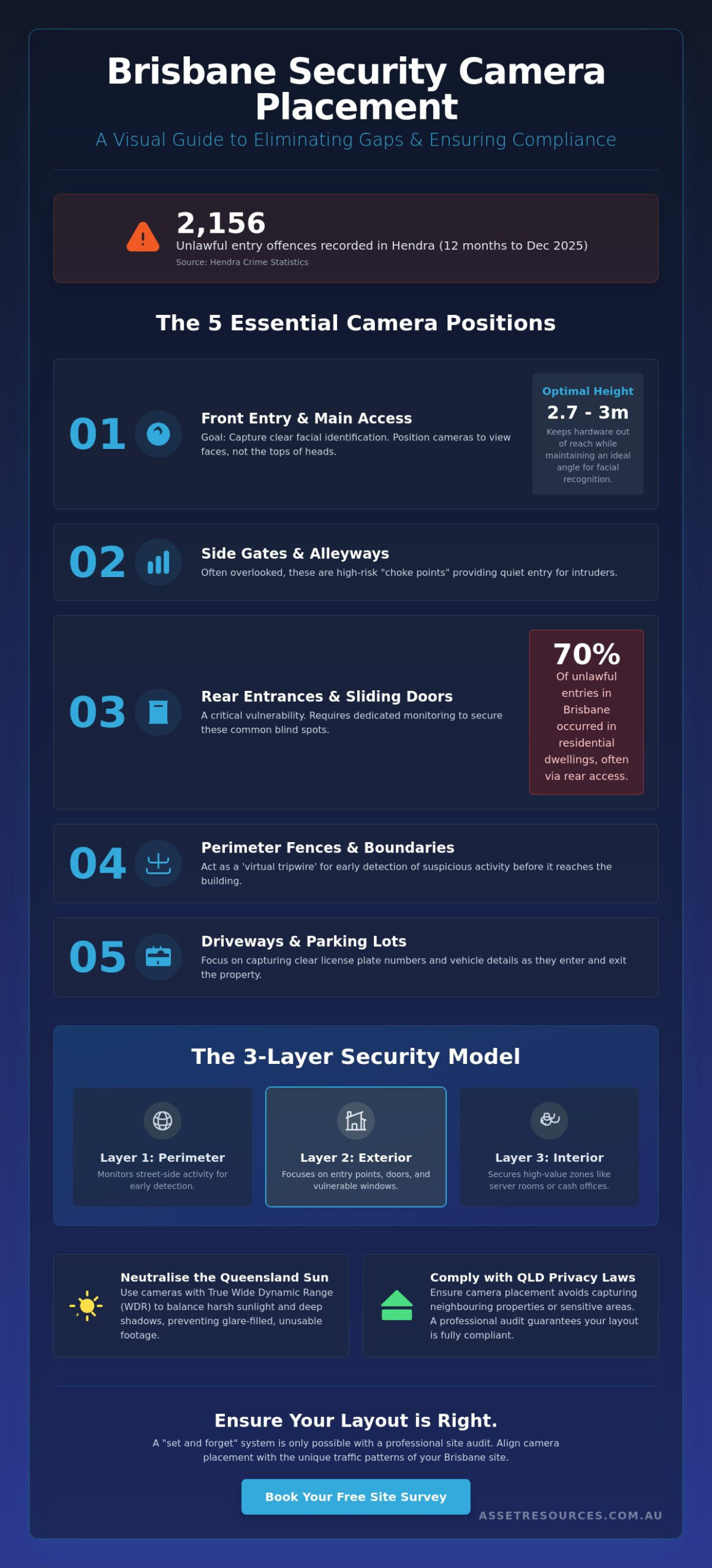
- Follow our security camera placement guide Brisbane to master the 5 essential positions, including the optimal 2.7 to 3-metre height for the front entry.
- Discover how to neutralise the harsh Queensland sun and high-contrast shadows by properly configuring Wide Dynamic Range (WDR) settings.
- Ensure your layout remains fully compliant with QLD privacy laws by avoiding common blind spot errors and boundary overreach.
- Understand how a professional site survey facilitates the seamless integration of surveillance with modern access control systems.
The Strategy of Surveillance: Why Placement Matters More Than Specs
Buying the most expensive 4K camera on the market won’t help if it only records the top of a thief’s cap. High-resolution sensors are useless without a strategic line of sight. This security camera placement guide Brisbane focuses on the “boots on the ground” logic that turns a group of cameras into a cohesive security asset. To get the best results, you need to think like an intruder and understand how they navigate a property. If you don’t have a clear path to capture facial features or license plates, the most advanced hardware in the world is just an expensive ornament.
Professionals use Crime Prevention Through Environmental Design (CPTED) to secure Brisbane sites. It’s about more than just hardware; it’s about using the physical environment to discourage crime. For industrial and commercial locations, this means managing lighting and landscaping while positioning cameras to exploit natural “choke points.” These are specific areas like narrow side gates, loading docks, or reception foyers where every visitor is forced to pass. By focusing high-resolution assets here, you guarantee a clear identification shot of every person entering the premises.
You also need to balance two primary goals. Visible cameras act as a deterrent, signaling that your property is a hard target. However, discreetly placed cameras often provide the best forensic value, capturing clear facial features or number plates without being tampered with first. Understanding what is CCTV in a modern 2026 context means treating it as a proactive management tool, not just a reactive recording device.
Understanding the 3-Layer Security Model
Effective surveillance works in concentric circles. Layer 1 monitors the perimeter and street-side activity for early detection. This is where you catch suspicious vehicles before they even enter your lot. Layer 2 focuses on exterior entry points and vulnerable glass areas like sliding doors or warehouse windows. Finally, Layer 3 secures interior high-value zones, such as server rooms, cash offices, or safe rooms. This layered approach ensures that if one camera is bypassed, another catches the intruder. It creates a safety-first environment that protects both your physical assets and your people.
The Role of Professional Security System Installation
A common mistake is “overlapping fatigue,” where too many cameras cover the same spot while leaving others blind. Adhering to a professional security camera placement guide Brisbane avoids this by using a site-specific layout audit. A professional security system installation ensures that every angle serves a specific purpose, from wide-angle situational awareness to tight-focus identification. This “set and forget” reliability is only possible when you align camera placement with the unique traffic patterns of your Brisbane site. It’s about building a system that holds up under pressure, ensuring every angle serves a specific purpose.
The 5 Essential Camera Positions for Brisbane Properties
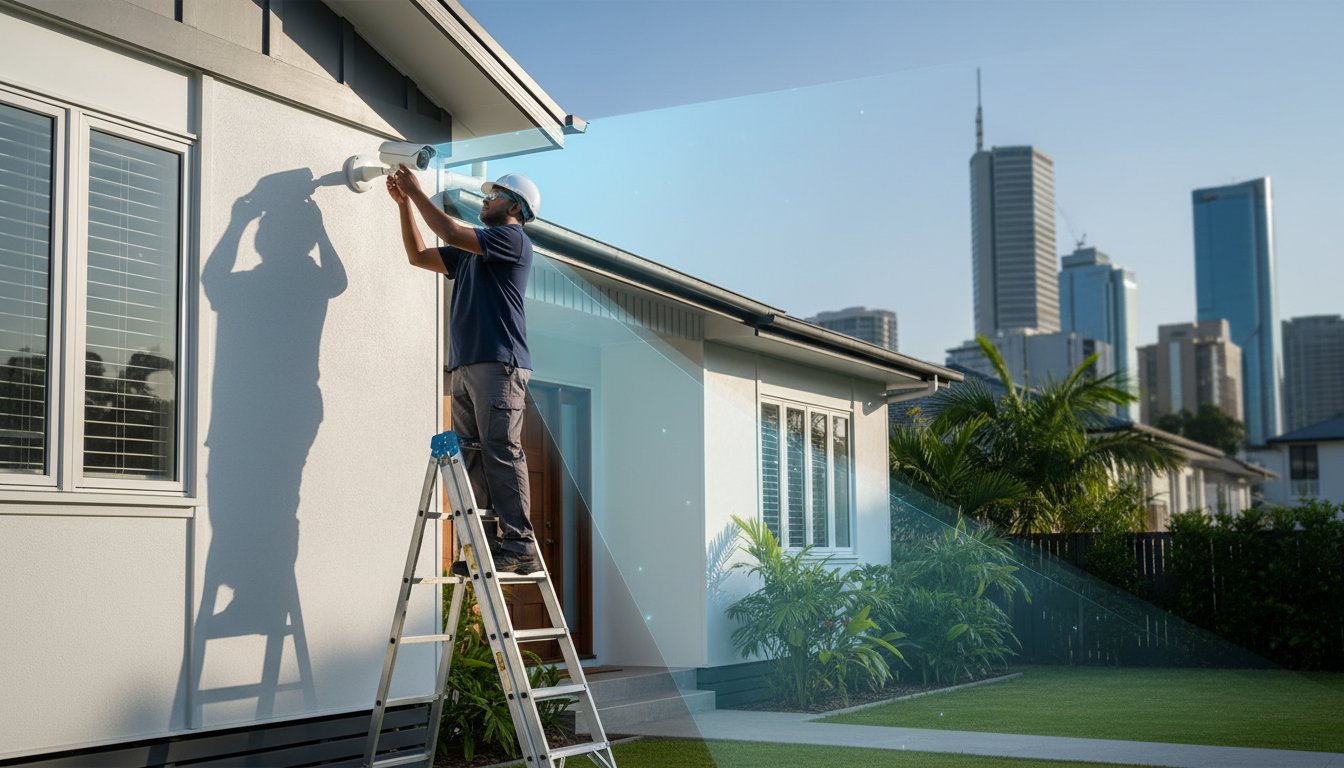
A strategic layout is the difference between a grainy blur and usable evidence. This security camera placement guide Brisbane highlights the five critical zones that every property owner must secure to create a comprehensive safety net. For the front entry, aim to capture clear facial identification by mounting cameras at a height of 2.7 to 3 metres. This height keeps the hardware out of reach while maintaining a natural angle for facial recognition. Side gates and alleyways are the most overlooked entry points in Brisbane suburbs, yet they often provide the path of least resistance for intruders seeking a quiet way in.
Rear entrances and sliding doors require heavy monitoring, as approximately 70% of unlawful entry incidents in Brisbane occurred in residential dwellings during the 2025 reporting period. In suburbs like Coorparoo, where break-ins rose by 39.29% by early 2026, securing these “blind” spots is a priority. For larger estates or industrial sites, perimeter fences should act as a virtual tripwire. Following a professional security camera placement guide Brisbane is the only way to ensure these assets provide real value when you need it most. If you’re looking to upgrade your property’s defenses, exploring tailored CCTV surveillance systems is a smart first step.
Optimising the Front Door Angle
Getting the front door right requires more than just pointing the lens at the welcome mat. To avoid “hat-brim” shadows that hide a person’s face, a 30-degree downward tilt is the industry standard. Use a wide-angle lens for broad porch coverage, but consider a narrower lens if you need to monitor a long, straight approach path. Referencing Brisbane City Council CCTV standards can help ensure your technical setup meets local best-practice requirements for image clarity and legal compliance.
Driveway and Asset Protection
Driveways and loading docks are high-traffic zones where capturing vehicle movement and licence plates is essential. This is particularly vital for industrial sites or larger properties utilizing farm mapping Brisbane to track assets across vast areas. To capture licence plates effectively at night, position cameras to avoid infrared “washout,” which happens when the reflective plate bounces too much light back into the lens. Always ensure you cover the blind side of parked machinery or vehicles where an intruder could easily crouch and hide from a single-camera setup.
Technical Factors: Optimising for the Brisbane Environment
Brisbane’s climate presents unique challenges that standard DIY setups often fail to handle. When following a security camera placement guide Brisbane, you must account for more than just the field of view. Subtropical storms and the intense Queensland sun can degrade hardware and ruin footage quality in months if you don’t choose the right specifications. This isn’t just about the camera’s resolution; it’s about how the device survives the environment it’s protecting.
High-contrast lighting is a constant battle in South East Queensland. A camera looking out from a dark garage into a sun-drenched driveway will often produce a “silhouette” effect where the intruder’s face is completely black. This is why Wide Dynamic Range (WDR) is essential for any professional layout. WDR technology balances bright backgrounds with dark foregrounds by combining different exposures into a single, clear frame. Without it, your midday footage will likely be unusable for police evidence.
Don’t overlook ingress protection and physical durability. An IP66 rating means your camera is protected against dust and powerful water jets, which is usually sufficient for under-eave mounting. However, for cameras on exposed poles or fences, an IP67 rating is better to survive Brisbane’s torrential summer downpours. In high-traffic commercial zones, vandal-proof housing with an IK10 rating is a “safety-first” requirement to prevent tampering or physical damage from intruders.
Lighting and Infrared Challenges
Night vision brings its own set of hurdles. High humidity in Brisbane can lead to moisture buildup or “IR fogging” on the lens during the transition from a hot day to a cool night. To counter this, we recommend using external sensor lights to assist the camera’s internal infrared. This reduces the load on the camera’s IR sensors and provides a clearer, colour image at night. Be careful with placement; mounting a camera too close to a white gutter or a reflective wall will cause IR “washout,” blinding the sensor and rendering the footage useless. Following an expert security camera placement guide helps you navigate these environmental variables to ensure your system remains operational 365 days a year.
Dealing with Sun Glare in South East Queensland
The sun’s track across the sky significantly affects your feed. North-facing cameras often deal with direct glare during the middle of the day, while south-facing units may struggle with deep, high-contrast shadows. Using deep-base mounts and sun shields helps with heat dissipation and prevents lens flare from ruining your image. It’s a pragmatic approach that ensures your “set and forget” system actually works when the sun is at its peak. This level of detail is what separates a professional layout from a basic “best guess” installation.
Avoiding Common Placement Mistakes & Blind Spots
A single blind spot is all an intruder needs to bypass your entire security network. Even when following a security camera placement guide Brisbane, many property owners fall into the trap of mounting cameras too high. While a height of five or six metres might seem like it offers a better “birds-eye” view, it usually results in high-quality footage of the tops of people’s heads. To capture usable facial features that hold up in court, you need to bring the lens down. Aim for that 2.7 to 3-metre sweet spot mentioned earlier to ensure you get eye-level detail without making the hardware easy to reach.
Obstructions are another major hurdle, especially with Brisbane’s fast-growing subtropical greenery. A palm frond that looks clear today can grow into your field of view within months, or trigger hundreds of false AI alerts during a windy afternoon. Spiderwebs are the “Brisbane special” for security systems; they reflect infrared light at night and can completely blind a sensor. Regular maintenance is a “boots on the ground” reality for any reliable system. You should also check for technical dead zones created by the camera’s own mounting bracket. If your layout doesn’t account for the physical footprint of the housing, you might leave a three-metre gap directly underneath the unit where an intruder can crouch unseen.
Cable vulnerability is a common placement failure that turns a professional system into a liability. If a thief can see an exposed Ethernet or power cable, they can snip it in seconds. We always recommend using metal conduit or deep-base junction boxes to keep wiring completely internal. Protecting these “assets” is just as important as the footage they record. If you aren’t sure if your current setup is vulnerable, it’s worth booking a professional CCTV surveillance systems audit to harden your perimeter.
Brisbane Privacy Regulations & Ethics
Staying compliant with local laws is a non-negotiable part of your layout strategy. Under Section 227A of the Queensland Criminal Code, it’s illegal to deliberately record private areas where a person has a reasonable expectation of privacy, such as a neighbour’s bedroom or backyard pool. Use “Privacy Masking” software to digitally black out these sensitive zones while still monitoring your own fence line. For commercial property owners in Brisbane City, where 1,934 unlawful entry offences were recorded in 2025, clear signage is also a legal requirement to notify the public that surveillance is in use.
The “Walk-Through” Test
Never assume your coverage is perfect until you’ve tested it. A professional blind-spot audit involves a “buddy system” walk-through where one person moves around the property while another monitors the live feed. You want to ensure that as a person leaves the Field of View (FoV) of one camera, they immediately enter the FoV of the next. This overlapping strategy ensures there are no “dead zones” near the walls or behind large structures like air conditioning units or rainwater tanks. It’s the only way to guarantee 100% coverage for your Brisbane site.
Professional Security Audits: Getting Your Brisbane Layout Right
A “best guess” approach to security is a gamble that rarely pays off. While this security camera placement guide Brisbane provides the foundational principles, every property has unique structural quirks and environmental variables. A professional site survey goes beyond basic coverage; it’s a technical assessment of light levels, cabling paths, and network bandwidth. For large-scale industrial sites or mining operations, we often utilise lidar drone technology to create precise 3D maps. This allows us to plan a layout that accounts for every topographical detail, ensuring your perimeter is truly secure before the first camera is even mounted.
Modern security isn’t a collection of isolated gadgets. It’s a unified network where your surveillance works in tandem with your access control systems. Imagine a scenario where an unauthorised person attempts to badge into a secure area. A professionally designed system will automatically swivel the nearest PTZ camera to that door and alert your phone with a live feed. This level of synchronization turns your cameras from passive recorders into proactive defense assets. If you already have hardware in place, booking a security camera inspection Brisbane is the best way to ensure your existing layout still meets 2026 standards.
Integrated Security Layouts
Effective placement directly supports your alarm systems Brisbane. When a sensor is triggered, visual verification is the most efficient way to confirm if there’s a genuine threat or just a false alarm caused by local wildlife. Positioning cameras to cover alarm zones allows for instant confirmation via a centralised security operations view. This streamlined workflow is essential for busy project managers who need to manage multiple sites without being bogged down by constant, unverified notifications. It’s about creating a reliable system that prioritises both safety and operational efficiency.
The Asset Resources Group Advantage
We bring a “boots on the ground” perspective to every project we touch. Asset Resources Group doesn’t just sell boxes; we build long-term partnerships based on integrity and specialized expertise. Whether you’re managing a remote mine site or a corporate office in Brisbane City, our solutions are tailored to the high-stakes requirements of your industry. We understand that your people and property are your most valuable assets, and we treat them with the respect they deserve. Don’t leave your coverage to chance. Contact Asset Resources Group for a professional Brisbane site audit to ensure your property is fully protected by a system that’s built to last.
Hardening Your Brisbane Perimeter with Professional Precision
Securing a property in South East Queensland requires more than just mounting high-end hardware; it demands a tactical layout that accounts for local sun angles and high-traffic choke points. This security camera placement guide Brisbane has highlighted why getting your camera height and environmental protections right is non-negotiable for capturing court-ready evidence. By moving beyond a “best guess” setup and focusing on integrated surveillance, you ensure your system works as a proactive defense rather than a passive recorder.
Our Queensland-based team brings a “boots on the ground” pragmatism to every project. We leverage deep local knowledge and extensive expertise in the high-stakes mining and construction sectors to protect your most valuable assets. We specialise in creating seamless, integrated solutions that combine CCTV, intruder alarms, and access control into a single, dependable network. Don’t leave your property’s safety to chance or poor angles. Request a Professional Security Site Audit from Asset Resources Group to harden your defenses today. We’re ready to help you build a system that stands up to the unique challenges of the Brisbane landscape.
Frequently Asked Questions
Is it illegal to point a security camera at a neighbour’s house in Brisbane?
It’s legal to record areas visible from your property for security purposes, but deliberately targeting private spaces like a neighbour’s bedroom or bathroom is illegal under Section 227A of the Queensland Criminal Code. You should use privacy masking software to black out sensitive areas. This ensures your system remains ethical and compliant with local Brisbane privacy standards.
What is the best height for security camera placement?
The optimal height for a security camera is between 2.7 and 3 metres from the ground. This security camera placement guide Brisbane recommends this specific range because it’s high enough to prevent easy tampering while staying low enough to capture clear facial features. Mounting cameras much higher usually results in footage of the tops of heads, which won’t help with identification.
Do I need a permit for security cameras in Brisbane?
Residential properties in Brisbane generally don’t need a council permit for standard camera installations as they’re considered “exempt development.” Exceptions might apply if your property is heritage-listed or if the installation involves significant new structures. It’s important to remember that any professional installer you hire must hold a current security licence issued by the Queensland Police Service.
How do I stop my security cameras from being spiderweb magnets?
You can reduce spider activity by applying a thin layer of silicone spray to the camera housing, but you must keep the spray away from the lens itself. Spiders are attracted to the heat and infrared light emitted by cameras at night. Using external sensor lights and disabling the camera’s internal IR can help move the attraction away from the lens surface.
Can security cameras see through glass windows at night?
Security cameras can’t see through glass at night if their internal infrared lights are active. The IR light reflects off the glass and creates a white glare that blinds the sensor. If you need to monitor an area through a window, you’ll need to disable the camera’s IR and rely on external street or sensor lighting to illuminate the scene.
What is the best camera angle to catch a car licence plate?
To capture a licence plate effectively, you need a narrow angle of view and a mounting position that’s as level with the vehicle as possible. An angle of less than 30 degrees is ideal to prevent the plate’s characters from distorting. You also need to manage infrared washout, which occurs when the camera’s light reflects too strongly off the plate’s surface.
How many cameras do I need for a standard 4-bedroom Brisbane home?
A standard 4-bedroom home typically requires a 4 to 6 camera system for comprehensive coverage. This setup usually covers the front door, rear sliding doors, side access gates, and the driveway. Larger properties or those with detached garages might need additional units to ensure there are no blind spots where an intruder could hide.
Should cameras be hidden or visible for the best deterrent?
A combination of both visible and discreet cameras offers the most reliable protection for Brisbane properties. Visible cameras act as a primary deterrent to discourage opportunistic thieves from targeting your site. Hidden cameras provide essential forensic backup, capturing clear footage if an intruder attempts to mask their face or disable the more obvious hardware.