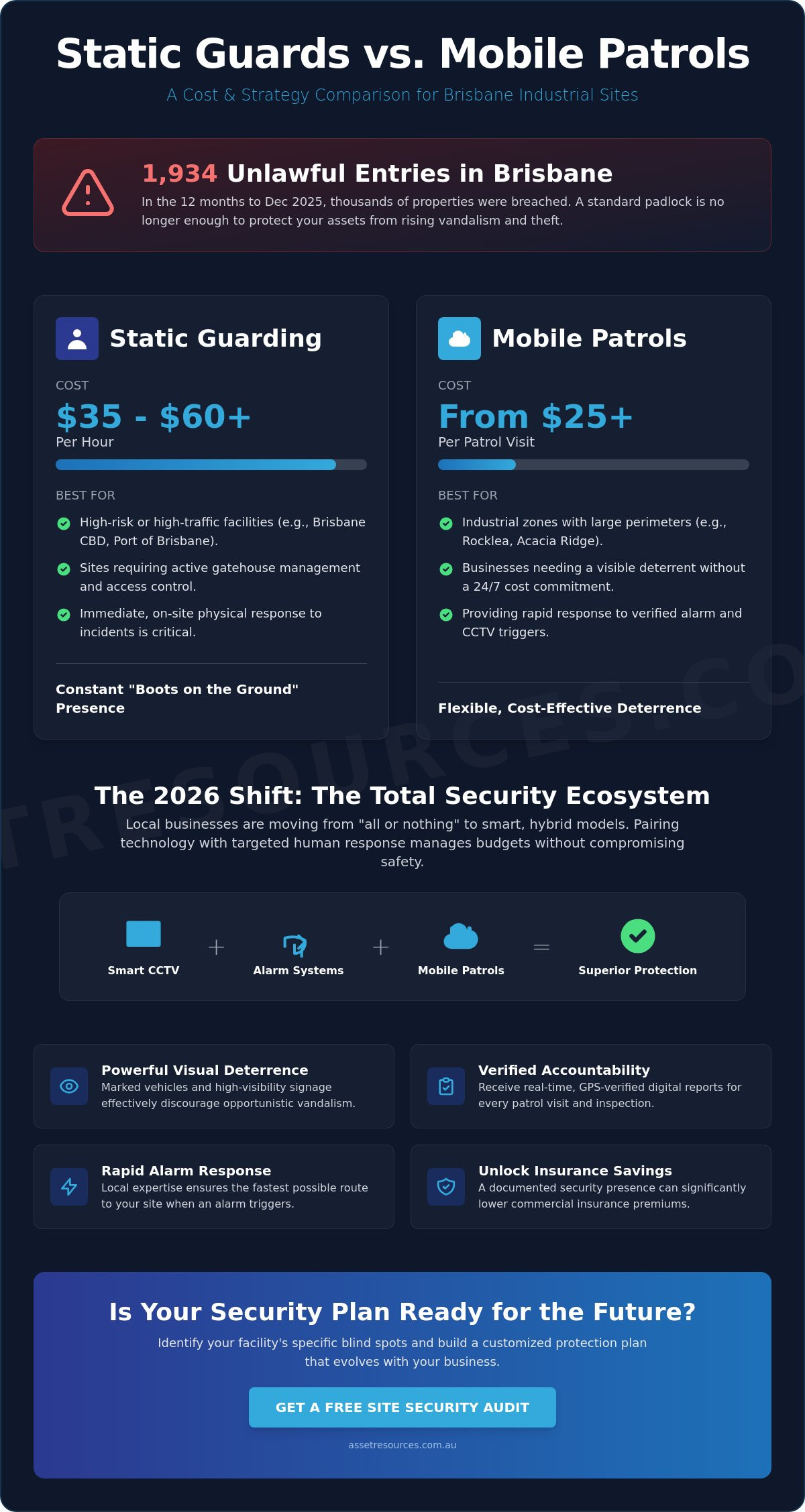
If your Brisbane industrial site was one of the 1,934 properties hit by unlawful entry in the 12 months leading up to December 1, 2025, you know a standard padlock isn’t enough. You’re likely feeling the squeeze between rising vandalism in local industrial zones and the high cost of full-time static guarding, which averages between $35 and $60 per hour. It’s a common dilemma; do you pay for a constant presence, or do you rely on mobile patrols and hope the response is fast enough when an alarm triggers?
We understand that protecting your assets requires a pragmatic, safety-first approach that respects your bottom line. This article compares the costs, response times, and strategic benefits of dedicated guarding versus patrol-based strategies to help you choose the right path for 2026. You’ll learn how a Total Security ecosystem, pairing smart hardware with rapid response, can offer better protection than a single guard at a lower cost. We’ll also break down why a $25 patrol might be your most effective deterrent this year.
Key Takeaways
- Compare the high cost of 24/7 static guarding against the strategic value of scheduled mobile patrols to find a budget-friendly solution for your Brisbane assets.
- Explore how visual deterrence through marked vehicles and high-visibility signage effectively discourages vandalism in South East Queensland industrial zones.
- Learn how to use high-definition CCTV to verify intruders before dispatch; this reduces unnecessary call-out fees and ensures a faster response when it matters most.
- Identify the potential for “hidden” savings on commercial insurance premiums by maintaining a documented, professional security presence that meets Queensland compliance standards.
- Get practical advice on conducting a site security audit to identify your facility’s specific blind spots and build a customized protection plan that evolves with your business.
Static Guards vs. Mobile Patrols: A Brisbane Business Comparison
Choosing between a permanent on-site presence and vehicle-based checks requires a clear understanding of your site’s specific risk profile. Static guarding provides a dedicated, fixed security professional who remains on your premises for a set shift. This model ensures constant surveillance and immediate intervention. Conversely, mobile patrols involve a security officer visiting your site at scheduled or randomized intervals in a marked vehicle to conduct perimeter checks and internal inspections. The core trade-off is simple; you’re balancing the absolute coverage of a static guard against the flexible, cost-effective deterrence of a mobile unit.
By early 2026, we’ve seen a distinct shift toward hybrid security models across South East Queensland. Local businesses are moving away from “all or nothing” approaches. Instead, they’re pairing high-tech hardware with targeted human response to manage budgets without compromising safety. While a static guard offers a visible “boots on the ground” authority, mobile patrols allow you to maintain a professional security presence across multiple locations or large perimeters for a fraction of the cost of a 24/7 placement.
When to Choose Static Guarding
Static guarding remains the gold standard for high-risk or high-traffic facilities where the cost of a breach far outweighs the hourly rate. If your operations are based in the Brisbane CBD or the Port of Brisbane, you likely deal with high-value assets and complex logistics. In these environments, Security guard roles and responsibilities extend beyond simple watching; they include active gatehouse management, visitor access control, and the enforcement of strict safety protocols. A permanent guard is essential for sites where an immediate physical response is required to prevent a safety incident or a major theft before it escalates.
When Mobile Patrols Are the Smarter Investment
For industrial zones like Rocklea or Acacia Ridge, where large perimeters make constant foot patrols impractical, mobile units are often the superior choice. Randomized checks are particularly effective because they prevent intruders from predicting a security schedule. This unpredictability, combined with high-visibility signage, serves as a powerful deterrent. Many business parks now utilize cost-sharing models, where multiple tenants split the fee for a patrol unit to circle the complex throughout the night. This approach provides professional-grade protection and rapid alarm response without the $35 to $60 hourly commitment of a dedicated on-site guard. It’s a pragmatic solution for businesses that need to secure their assets while maintaining a lean operational budget.
How Professional Mobile Patrols Operate in South East Queensland
Professional mobile patrols in South East Queensland function through a tight loop of communication and rapid deployment. When a sensor triggers at your facility, the 24/7 monitoring centre immediately locates the nearest patrol unit via GPS. This isn’t just about seeing a dot on a map; it’s about having officers who understand the specific layout of local industrial hubs. While some national providers rely solely on software, local expertise ensures guards know which backstreets avoid Gympie Road traffic or how to access a specific gatehouse during a storm. This “boots on the ground” knowledge is what separates a standard service from a reliable partnership.
Visual deterrence is the first line of defense. A marked patrol vehicle parked under high-intensity lighting sends a clear message to opportunistic vandals. This strategy aligns with Queensland business security principles, which emphasize that visible security measures significantly reduce the likelihood of unlawful entry. Every visit is backed by real-time digital logs. You receive a GPS-verified report showing exactly when the officer arrived, which checkpoints they scanned, and any photos of potential vulnerabilities found. This level of accountability ensures you’re getting the protection you pay for without having to micromanage the process.
The Anatomy of a Site Inspection
An effective inspection is more than just a drive-by. Officers exit the vehicle to physically test entry points, windows, and perimeter gates for signs of forced entry. They verify that access control systems remain un-tampered and fully operational. Beyond looking for intruders, they identify “soft” risks. This might include an unsecured ladder left against a warehouse wall or a delivery door that didn’t latch properly. Catching these small oversights prevents them from becoming major security breaches later in the night.
Response Times and Logistics in Brisbane
Speed is critical when an alarm sounds. Because patrol units are already on the road, they often reach a site faster than a stationary guard could react to a distant perimeter breach. In Brisbane, logistics are managed through regional hubs. Units on the Northside handle areas like Brendale and Northgate, while Southside units focus on the Logan and Ipswich corridors. This regional focus minimizes the impact of peak-hour congestion and ensures that the $40 to $100 call-out fee results in a timely arrival. If a breach is confirmed, the officer initiates “back-to-base” protocols and liaises directly with the Queensland Police Service. To ensure your site is ready for this level of protection, consider an Asset Resources Group security consultation to map out your response zones.
Calculating ROI: Is a Mobile Patrol Worth the Cost?
Determining the return on investment for security starts with a hard look at the numbers. A 24/7 static guard in Brisbane typically costs between $35 and $60 per hour. Over a single weekend, that investment exceeds $1,600. In contrast, mobile patrols often range from $25 to $50 per patrol. Scheduling three random checks per night provides a visible deterrent and physical verification for a fraction of the cost of a permanent placement. For many industrial operators, this shift in strategy frees up capital for other operational needs without leaving the site vulnerable during high-risk hours.
The financial benefits extend beyond the service fee. Professional patrols often lead to “hidden” savings through lower commercial insurance premiums. QLD insurers recognize that a documented security presence reduces the likelihood of a successful claim. When you quantify the cost of a single break-in, including stolen tools, damaged entry points, and operational downtime, the annual cost of mobile patrols is easily justified. It’s a pragmatic approach to loss prevention that treats security as a manageable operational expense rather than an unpredictable liability.
Analyzing Brisbane Crime Data for Your Suburb
Frequency should always be dictated by local risk. With 1,934 unlawful entry offences recorded in the Brisbane CBD in the 12 months leading up to December 1, 2025, the need for vigilance is clear. However, industrial hubs like Eagle Farm or Rocklea present different challenges. These areas often require higher randomization in patrol timing to ensure intruders can’t “clock” the security vehicle’s routine. We recommend using QLD Police Service crime maps to track trends in your specific postcode. This data allows you to scale your security up during seasonal peaks, such as the Christmas and New Year shutdown periods when industrial zones become primary targets for theft. For sites in high-risk precincts like Eagle Farm or Pinkenba, pairing randomized patrols with dedicated emergency response support for Brisbane industrial assets ensures that every verified alarm triggers a coordinated, professional intervention rather than a delayed reaction.
The Compliance Aspect: QLD Security Providers Act
Integrity in security isn’t just about showing up; it’s about legal compliance. Your provider must meet the strict requirements of the Security Providers Act 1993. This ensures that every officer on your site has undergone mandatory criminal history checks and fingerprinting, which costs $156.70 per person in government fees alone. Using a licensed provider protects your business from the liability of using “cowboy” operators. Professional, GPS-verified reporting is also critical if you ever need to file an insurance claim. Without a verified log of security activity, proving that you took “reasonable steps” to secure your assets becomes significantly harder in the eyes of an assessor.
Integrating Hardware: Making Patrols Smarter with CCTV and Alarms
Hardware alone is just a witness; a patrol unit is the response. In 2026, the most effective Brisbane security strategies rely on the “Verified Alarm” advantage. Instead of blindly dispatching a vehicle every time a sensor trips, high-definition video allows monitoring teams to confirm a human intruder in real-time. Professional CCTV installation in Brisbane significantly reduces the frequency of “false alarm” call-out fees, which typically range from $40 to $100 per event. By only triggering mobile patrols when a threat is verified, you ensure your security budget is spent on actual protection rather than investigating stray cats or wind-blown debris.
Smart perimeters now use AI-driven sensors to distinguish between routine movement and suspicious activity. These systems can grant patrol officers temporary, secure entry via integrated intercoms or remote gate releases. This eliminates the delay of fumbling with physical keys during an emergency. It’s a seamless hand-off from digital detection to physical intervention. This integration turns passive equipment into an active part of your “boots on the ground” defense strategy.
Visual Verification and Evidence
Real-time video feeds do more than just confirm a break-in; they give officers tactical intelligence. Before arriving, a patrol unit can see the number of intruders, their exact location, and whether they’re carrying tools or weapons. This preparation is vital for the safety of the officer and the quality of the response. For expansive sites in the Port of Brisbane or large-scale civil projects, thermal imaging and drones provide a bird’s-eye view that a single guard on foot simply cannot match. Linking your security systems in Brisbane QLD to a central response hub ensures that data is captured as evidence. This is essential for police liaison and successful insurance claims following an incident. For venue operators managing high-density crowds, a dedicated approach to event venue CCTV installation in Brisbane ensures full visibility across sprawling floor plans and eliminates the blind spots that put patrons and licensees at risk.
The Role of Intruder Alarms in Patrol Efficiency
Efficiency depends on strategic sensor placement. We don’t just put sensors on every door; we map out “choke points” where an intruder must pass to reach your assets. This back-to-base monitoring acts as the critical link between your hardware and the patrol vehicle. When a perimeter is breached, automated dispatch systems can cut response lag by sending the alert directly to the officer’s in-car terminal. This removes the middleman and puts mobile patrols exactly where they’re needed in minutes. It’s a procedural excellence that mirrors the organized nature of a successful project mobilization.
If your current setup feels disconnected, it’s time to bridge the gap between your gear and your guards. Talk to Asset Resources Group about a hardware integration audit to ensure your site is truly secure.
Next Steps: Building Your Total Security Plan in Brisbane
Building a resilient security strategy requires moving beyond generic solutions. A successful plan starts with a comprehensive site security audit to identify the specific blind spots that cameras might miss. This includes checking the physical integrity of perimeter fencing and assessing the lighting in high-risk zones. By identifying these vulnerabilities first, you can design a “Total Security” ecosystem where mobile patrols act as the decisive response to detected threats. This pragmatic approach ensures your human capital is utilized where it provides the most value.
Customization is the key to deterrence. A “one size fits all” schedule is easy for intruders to bypass once they recognize the pattern. The Asset Resources Group approach focuses on building the necessary infrastructure, such as remote access and clear signage, that allows mobile patrols to do their jobs effectively. This isn’t just about driving past a gate; it’s about creating a procedural excellence that protects your assets and maintains site safety through unpredictable, high-visibility checks.
Choosing a Local Brisbane Partner
Selecting from the various security firms in Brisbane is a decision that impacts your long-term operational stability. Local partners offer a distinct advantage over national call centres because they possess regional expertise. They understand the specific risks associated with Brisbane’s construction and retail sectors. When evaluating a partner, check for local references and ensure they provide the technical support needed to back up their physical patrols. You need a partner who is as comfortable on a remote industrial site as they are in a corporate boardroom.
Requesting a Tailored Security Proposal
When you’re ready to upgrade your protection, provide a brief that includes site maps, a list of high-value assets, and any historical incident data. This transparency allows for a more accurate risk assessment. A site walk-through with an Asset Resources Group technical specialist is a non-negotiable part of this process. It allows us to see the “ground truth” of your operations and suggest improvements that hardware alone cannot solve. Taking these steps ensures your security plan is a tailored solution rather than a generic expense. Secure your Brisbane assets with a professional security consultation today.
Securing Your Brisbane Operations for 2026 and Beyond
Protecting your assets in 2026 requires a shift from reactive watching to a proactive, technology-led response. You’ve seen how the 1,934 unlawful entries recorded in the Brisbane CBD through late 2025 necessitate a smarter approach. By moving away from the high overhead of full-time static guarding and utilizing the randomized deterrence of mobile patrols, you can maintain a high-security posture without the $1,600 weekend price tag. The most successful Brisbane operators are those who bridge the gap between their hardware and their human response.
Integrating AI-driven CCTV with a “boots on the ground” patrol unit ensures every alarm is verified and every breach is met with professional intervention. As an Australian-owned and operated firm specializing in South East Queensland industrial security, we provide the integrated hardware and response expertise your site deserves. We’re ready to help you build a system that prioritizes both safety and quality. Design your integrated security system with Asset Resources Group and gain the peace of mind that comes from a partnership built on integrity. Your assets are your most valuable investment; let’s protect them with a strategy that works as hard as you do.
Frequently Asked Questions
What is the difference between a mobile patrol and a static guard?
A static guard provides a permanent, fixed presence on your property for the duration of their shift, whereas mobile patrols involve a security officer visiting your site at predetermined or randomized times. Static guarding is ideal for high-traffic gatehouses or facilities requiring constant surveillance. Patrols offer a flexible, vehicle-based alternative that allows an officer to cover multiple checkpoints or large perimeters during a single visit.
How often should a mobile patrol check my Brisbane business?
Frequency depends on your site’s specific risk profile and the value of your assets. For high-risk industrial zones, we typically recommend at least three randomized checks per night to prevent intruders from identifying a routine. Some businesses opt for a single check during low-risk periods, while others scale up to hourly visits during high-theft windows like long weekends or the December holiday shutdown period.
Do mobile patrols respond to alarm activations?
Yes, responding to alarm activations is a core function of professional patrol services. When your monitoring centre detects a breach, they dispatch the nearest available unit to investigate immediately. This ensures a trained professional is on-site to verify the threat, secure the premises, and liaise with the Queensland Police Service if necessary. This response is often much faster than waiting for a site manager to arrive from home.
Are mobile patrols effective at deterring crime in industrial areas?
They are highly effective due to the visible deterrence of marked vehicles and professional signage. In industrial areas with large perimeters, a vehicle-based officer can cover more ground than a foot patrol. The randomized nature of these checks makes it difficult for criminals to plan a break-in, as they can’t predict when the next unit will arrive to inspect loading docks or perimeter gates.
How much does a mobile patrol service cost in Brisbane?
Basic monitoring plans in Brisbane can start from $6 per day, while individual patrol visits typically range from $25 to $50 each. The final price varies based on your location, the number of internal checkpoints required, and the frequency of the visits. Alarm response call-outs usually incur a separate fee, which generally falls between $40 and $100 depending on the time of the activation and site location.
Can mobile patrols monitor my internal premises as well as the perimeter?
Yes, officers can conduct internal inspections if they are provided with secure access keys or digital codes. During an internal check, the officer walks through the facility to ensure all internal doors are locked, machinery is powered down, and no unauthorized persons are on-site. This is a pragmatic solution for businesses storing high-value equipment or sensitive assets within a main warehouse or office.
What happens if a patrol officer finds a break-in at my site?
If an officer discovers a breach, they immediately secure the area and notify the 24/7 monitoring centre. They will call the Queensland Police Service and remain on-site until the premises are secured or you arrive. The officer also documents the scene with photos and a digital incident report. This documentation is essential for your insurance claim and any subsequent legal proceedings following the incident.
Do I need an alarm system if I already have mobile patrols?
We strongly recommend using both for a complete security solution. Mobile patrols provide physical deterrence and manual checks, but an alarm system provides constant, 24/7 electronic surveillance. When these systems are integrated, the alarm acts as the trigger that brings the patrol officer to your site exactly when they’re needed. This combination creates a “Total Security” ecosystem that is far more effective than either service alone.