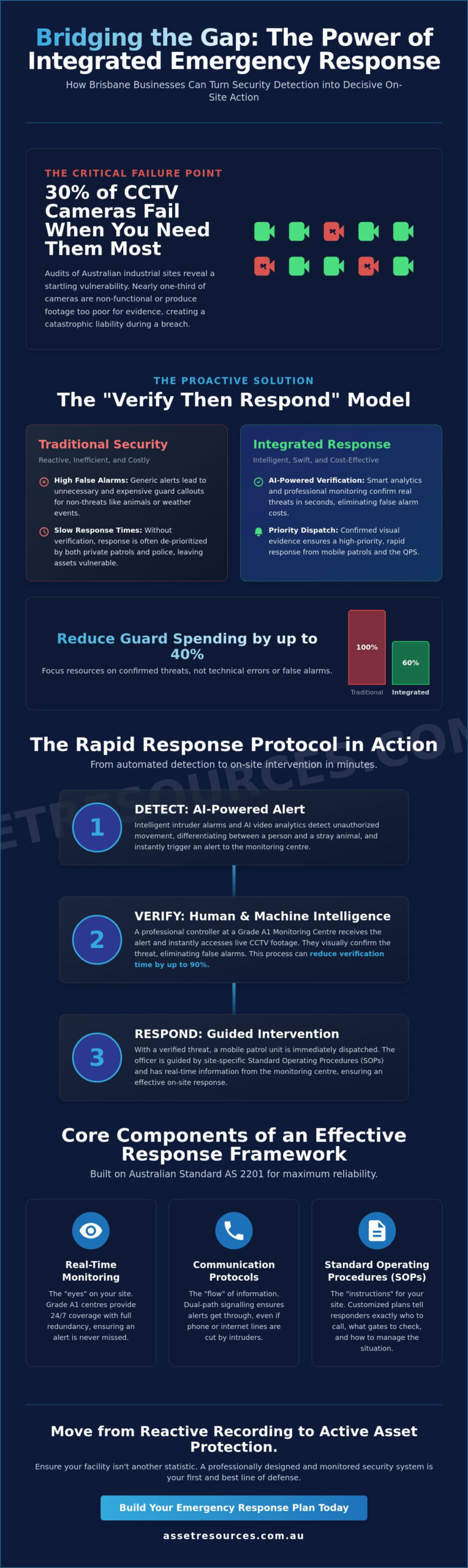
Audits of Australian industrial sites reveal that 30% of CCTV cameras are currently non-functional or produce images too poor to be used as evidence. For a project manager in Eagle Farm or Pinkenba, this technical failure becomes a catastrophic liability when your site lacks dedicated emergency response support. Relying on generic security providers often leads to slow response times and unnecessary mobilization costs, leaving your high-value assets vulnerable during the critical minutes of a breach.
You likely understand that hardware alone isn’t a deterrent. This article explores how to integrate advanced security systems with rapid emergency response support to protect your Brisbane business from evolving threats in 2026. We’ll detail the shift toward “verify then respond” models and explain how high-spec emergency response support can reduce guard spending by up to 40% while maintaining strict compliance with Australian monitoring standards. From mapping high-risk zones to selecting Grade A1 monitoring, discover how to build a seamless link between your site’s technology and physical intervention.
Key Takeaways
- Learn how professional emergency response support bridges the critical gap between detecting a security breach and physically interrupting it on-site.
- Discover how integrated CCTV hardware and AI-driven video verification can eliminate the costs associated with false alarms and unnecessary mobilizations.
- Compare security monitoring tiers for South East Queensland to determine whether self-monitoring or professional patrols are the right fit for your site’s risk profile.
- Identify hidden site vulnerabilities and establish clear Standard Operating Procedures (SOPs) to ensure a high-speed, compliant response from your monitoring centre.
- Understand the “verify then respond” model that allows Brisbane businesses to focus their security resources on confirmed threats rather than technical errors.
Defining Professional Emergency Response Support for Brisbane Businesses
Professional emergency response support is often misunderstood as a general call for help. In a commercial context, it’s a technical ecosystem designed to bridge the gap between detecting a security breach and physically interrupting it. For businesses operating in high-stakes Brisbane industrial zones like Eagle Farm or the Port of Brisbane, this support is the difference between a successful asset recovery and a total loss. While 61% of organizations with integrated security report better threat detection, detection alone doesn’t stop a crime. You need a verified protocol that triggers the immediate mobilization of mobile patrols or the Queensland Police Service (QPS).
Asset Protection vs. Public Safety
It’s vital to distinguish between public emergency services and private asset protection. Calling 000 is for immediate threats to life or active, high-priority crimes. However, the QPS often requires verification before dispatching units to a commercial alarm to avoid wasting resources on the high volume of false triggers. This is where your monitoring centre steps in.
Private security provides the “boots on the ground” reliability that industrial sites require. By using a licensed security firm, you reduce the burden on public services while ensuring a guaranteed response. With retail theft increasing by 15% in major Australian cities, having a dedicated responder who knows your site’s layout and high-value “assets” is a pragmatic necessity. It’s about taking responsibility for your perimeter rather than waiting in a public queue. Complementing this approach with crime prevention through environmental design strategies can further reduce your site’s vulnerability by making it a less attractive target before a breach is ever attempted.
Key Components of a Security Response Framework
An effective response doesn’t happen by accident. It relies on a structured framework that meets Australian Standards (AS 2201) for alarm monitoring and response. This framework includes:
- Real-time Monitoring: These are the “eyes” on your site. When a sensor is tripped, a professional controller verifies the footage immediately to confirm a human presence.
- Communication Protocols: Information must flow fast. A clear line from the site’s hardware to the monitoring centre, and then to the mobile patrol officer, ensures no time is wasted.
- Standard Operating Procedures (SOPs): These are your specific instructions. They tell the responder exactly what to do, whether it’s checking the rear gate at a Pinkenba warehouse or calling a specific site manager at 2:00 AM.
This integrated approach ensures that emergency response support is proactive. It moves your security posture from reactive recording to active asset protection, ensuring that your facility isn’t just another statistic in a 2026 crime report.
The Technology Behind Rapid Security Mobilization
High-spec hardware is the foundation of any reliable defense strategy. In the Brisbane industrial sector, “set and forget” security is a liability. Modern systems now rely on Grade A1 Monitoring Centres, which represent the Australian gold standard for facility security. These centres operate with full redundancy and high-level encryption, ensuring that emergency response support is triggered within seconds of a verified event. By utilizing AI-powered video analytics and sensor fusion, these systems proactively detect unauthorized movement before a physical breach even occurs. This shift toward intelligent automation has been shown to reduce alarm verification times by up to 90% compared to traditional manual monitoring.
The Role of Intelligent Intruder Alarms
Modern alarm systems in Brisbane do far more than trigger a local siren. They serve as the primary communication link to a central station, using dual-path signalling to ensure the alert reaches a controller even if intruders attempt to cut phone or internet lines. This back-to-base monitoring provides 24/7 coverage for unstaffed or remote sites. When a sensor is tripped at a warehouse in Hendra or a yard in Acacia Ridge, the system immediately transmits data to the monitoring centre, initiating the mobilization protocol without delay.
CCTV Integration for Visual Verification
In Queensland, the Queensland Police Service (QPS) often requires visual confirmation of a crime in progress before assigning a priority response to a commercial alarm. Integrated CCTV surveillance systems provide this essential “verify then respond” capability. By confirming a threat through high-definition footage, businesses can eliminate the costs associated with false alarm call-outs. Implementing this model has been shown to reduce annual spending on security guards by 20% to 40% while ensuring human responders focus their efforts on genuine threats.
Site managers also benefit from mobile remote viewing, allowing for real-time decision-making from any location. In 2026, the adoption of high-definition recording ensures that if an incident does occur, the footage serves as high-quality evidence for recovery and prosecution. This same principle applies across a wide range of commercial environments — for example, event venue CCTV installation in Brisbane follows comparable verification standards to meet strict Liquor Act compliance and protect patrons in high-density crowd settings. This technological synergy ensures that your emergency response support is both accurate and rapid. If you want to ensure your site is fully protected, a professional security integration audit can identify where your current hardware might be failing to trigger an effective response.
Comparing Security Response Tiers for South East Queensland
Security isn’t a one-size-fits-all service. A small office in Milton doesn’t require the same intensity of emergency response support as a heavy machinery yard in Yatala. Choosing the wrong tier leads to either wasted budget or, worse, a catastrophic delay during a breach. In 2026, Brisbane businesses typically choose from four distinct levels of response, each with its own risk profile and cost structure.
- Tier 1: Self-Monitoring: You receive app alerts directly to your phone. It’s cost-effective but dangerous for high-value assets. If you’re asleep or in a dead zone, the alert is missed.
- Tier 2: Professional Monitoring with Keyholder Notification: A Grade A1 centre monitors your site and calls you if an alarm trips. This adds a layer of accountability, but it still requires you or a staff member to drive to the site at 3:00 AM, which creates significant safety and liability concerns.
- Tier 3: Rapid Mobile Patrol Response: This is the industrial standard. A licensed security professional, usually costing around $38 plus GST per hour in Brisbane, is dispatched immediately to investigate.
- Tier 4: Police Attendance: The Queensland Police Service (QPS) is the final escalation point for verified criminal activity or immediate threats to life.
Mobile Patrols: The Industrial Workhorse
In Brisbane’s industrial corridors like Geebung or Wacol, mobile patrols are the most effective deterrent. A patrol officer doesn’t just drive past; they perform “boots on the ground” checks. This involves physical inspections of perimeter fencing, ensuring heavy vehicle gates are locked, and checking for signs of forced entry. Because visible patrols combined with motion-activated security result in 40% fewer incidents, this tier provides the best balance of cost and asset protection. Response times in metro Brisbane are significantly faster than in regional Queensland, making patrols a viable primary response strategy for suburban warehouses.
When to Escalate to Emergency Services
Escalating to the QPS requires a clear understanding of their “verification” rule. In Brisbane, police typically won’t attend a commercial alarm unless a security provider or site manager confirms a crime is in progress through video or physical evidence. This is why emergency response support must include a verification step. Your monitoring centre acts as the coordinator, ensuring that when the police are called, they have the high-quality evidence needed to justify a priority dispatch. In multi-hazard emergencies, such as a fire caused by an intruder, the monitoring centre also handles the simultaneous mobilization of Fire and Ambulance services, ensuring a unified response to complex site threats.
Designing a Critical Response Plan for Your Site
A rapid response is only as effective as the plan behind it. Without clear instructions, even the fastest patrol officer might waste precious seconds searching for the right entry point or contact person. To build a robust defense, you should start with a comprehensive commercial security checklist to identify physical vulnerabilities. Once you’ve hardened the perimeter, you must establish clear Standard Operating Procedures (SOPs) for your monitoring centre. These SOPs act as a script for emergency response support, ensuring that controllers know exactly which gates to check and which managers to call during an after-hours incident.
Defining your escalation path is the next critical step. Your list of authorized contacts needs to be current and tiered. If the primary site manager doesn’t answer within three rings, the system should automatically roll over to the next person in the chain of command. Regular testing of this hardware-to-response link is essential. In 2026, proactive businesses perform monthly “silent tests” to ensure that signals are reaching the Grade A1 centre and that the mobilization data is accurate. If you haven’t reviewed your escalation paths in the last six months, your site is at risk of a communication breakdown during a real breach.
Mapping High-Risk Zones
Not all areas of your site are created equal. You need to identify “Asset-Rich” zones, such as server rooms, tool stores, or heavy vehicle bays, that require immediate, high-priority response. Modern access control systems can be programmed to automatically lock down these specific zones the moment a perimeter breach is verified. For large-scale industrial sites in the Brisbane Port area, integrating thermal imaging or drone support provides additional perimeter oversight. This allows responders to track intruders across vast yards before they reach your most valuable equipment. With 52% of security professionals now considering touchless access control essential, upgrading your entry points is a key part of this zone-based defense strategy. Pairing these technological measures with crime prevention through environmental design principles — such as strategic lighting, natural surveillance, and territorial reinforcement — creates a layered deterrent that discourages intrusion attempts before your electronic systems are ever triggered.
The Human Element: Training and Compliance
Hardware and plans are useless if your people aren’t prepared. Under the model Work Health and Safety (WHS) laws in Australia, every workplace is required to have an emergency plan that is easily accessible and regularly reviewed. Your staff must know exactly what to do when an emergency response is triggered to avoid interfering with professional responders or putting themselves in harm’s way. This training ensures that your emergency response support remains a coordinated effort rather than a chaotic one.
After any incident, use the response data and patrol reports to conduct a “post-mortem.” This reporting helps you identify gaps in your plan and harden your site against future threats. If you need help drafting a professional plan for your facility, contact Asset Resources Group for a site security consultation today to ensure your operations remain safe and compliant.
Asset Resources Group: Your Partner in Emergency Readiness
Asset Resources Group (ARG) understands that in the mining, civil, and construction sectors, your property isn’t just real estate; it’s a collection of critical assets that drive your revenue. We don’t just sell cameras. We build the technical infrastructure that makes rapid emergency response support possible. In an era where 30% of industrial CCTV cameras fail to produce usable evidence during an audit, our “safety-first” approach ensures your hardware is always operational and ready for mobilization. We provide the high-performance sensors and AI-driven analytics that act as the primary trigger for action, ensuring your site is never left vulnerable due to equipment neglect.
Our expert installation team tailors every system to the unique geography of Brisbane’s industrial landscape. Whether you’re managing a high-traffic yard in Eagle Farm or a remote facility on the city’s outskirts, we ensure your alarms and CCTV are seamlessly integrated with Australia’s leading Grade A1 monitoring providers. This connection is what transforms a simple recording device into a proactive defense tool. By bridging the gap between hardware and human action, we ensure that when a breach is detected, the response is immediate, professional, and compliant with all Australian security standards.
Why Brisbane Businesses Trust ARG
Local expertise is our greatest strength. We’ve built our reputation on the “boots on the ground” pragmatism that South East Queensland’s industrial leaders respect. We don’t just install; we design integrated security ecosystems that address the specific challenges of 2026, from the 15% rise in urban retail theft to the technical requirements of large-scale construction sites. Our team carries the technical authority needed to protect high-value assets in the resource and government sectors, treating every project as a partnership rather than a transaction. We’re as comfortable in a boardroom discussing compliance as we are on a dusty mine site ensuring a perimeter sensor is perfectly calibrated.
Get Started with a Site Security Audit
The first step toward a more resilient facility is a professional site security audit. These audits are designed to identify the hidden gaps in your current emergency response support, such as “blind spots” in your CCTV coverage or outdated escalation paths that lead to slow response times. We don’t believe in one-size-fits-all packages. Instead, we customize a hardware and monitoring solution that aligns with your specific risk profile and budget.
Don’t wait for a critical incident to reveal the weaknesses in your defense. Our Brisbane team provides no-nonsense security consultations that focus on results and reliability. We’ll help you implement the “verify then respond” model that has been shown to reduce security guard spending by up to 40% while significantly improving asset protection. Contact Asset Resources Group today to book your audit and ensure your Brisbane business is ready for any emergency.
Take Control of Your Site Resilience
Securing a Brisbane industrial site in 2026 requires more than just high-definition cameras. It demands a technical ecosystem where every alarm is verified and every response is calculated. You’ve learned how integrating Grade A1 monitoring with your hardware can slash verification times and ensure your assets are protected against local crime trends. Establishing a clear escalation path and testing your hardware-to-human link are the final steps in moving from a reactive posture to a resilient, proactive defense.
Asset Resources Group stands as your partner in this mission. We’re an Australian owned and operated business specializing in industrial asset protection for the sectors that build our country. We don’t just install equipment; we provide the emergency response support and integrated monitoring solutions that keep your operations running safely. Our team understands the high-stakes nature of the resource industry and delivers the reliability your project demands.
Secure Your Site: Request Emergency Response Support Consultation
Let’s get your facility secured with the pragmatism and technical expertise your business deserves.
Frequently Asked Questions
What is the difference between an alarm and emergency response support?
An alarm is a technical trigger that detects a breach, while emergency response support is the human and logistical action that follows. Support involves a Grade A1 monitoring centre verifying the alert and coordinating the mobilization of mobile patrols or police. It’s the difference between hearing a noise and having a professional team on-site to stop a theft in progress.
Does the Queensland Police Service (QPS) respond to all business alarms?
No, the Queensland Police Service (QPS) doesn’t attend every commercial alarm. Due to the high volume of technical errors, police typically require “verification” through video footage or a physical report from a security officer before dispatching a unit. This policy ensures that emergency services focus on active crimes rather than low-priority false triggers.
How quickly can a mobile patrol arrive at my Brisbane site?
Arrival times depend on your site’s proximity to patrol routes, but metro Brisbane sites typically see a response within 15 to 30 minutes. Regional industrial yards may take longer depending on local infrastructure. Professional emergency response support focuses on rapid mobilization to secure your assets before intruders can cause significant damage or remove equipment from the premises.
What is video verification, and why do I need it for emergency response?
Video verification is the process where a monitoring controller views live footage from your CCTV system to confirm a breach. This is essential because it allows for a priority police response and eliminates the costs of false alarm call-outs. AI-powered analytics in 2026 can reduce the time it takes to verify these threats by up to 90%, ensuring faster action.
Can I monitor my own security system and call for help myself?
You can use app-based self-monitoring, but it carries high risks for industrial sites. If you’re out of range or asleep, a breach goes unnoticed until the next morning. Professional monitoring provides a 24/7 safety net, ensuring a trained controller manages the incident while you remain safe and away from a potentially dangerous confrontation.
What happens if there is a false alarm at my business?
If a false alarm occurs, a verified monitoring system identifies the error before a patrol is dispatched. This saves you the expense of unnecessary call-out fees. For systems without video, a mobile patrol officer will attend to perform a perimeter check, ensuring the site is secure before resetting the system and providing a detailed incident report.
Is emergency response support available for remote industrial sites in QLD?
Yes, specialized support is available for remote Queensland sites through dual-path signaling and satellite-linked hardware. These systems ensure that even if local phone lines fail, a signal reaches the monitoring centre. Mobilization is then coordinated with the nearest available responders or local authorities to protect high-value assets in the resource and mining sectors.
How do I choose the right monitoring level for my Brisbane commercial property?
Your monitoring level should align with your specific risk profile and the value of your assets. High-risk sites like tool stores or machinery yards require tiered support with rapid patrol attendance. A professional security audit is the most reliable way to determine which level of support keeps you compliant with Australian Standard AS 2201. For businesses that also manage public-facing venues, reviewing the requirements for event venue CCTV installation in Brisbane can provide additional guidance on meeting industry-specific compliance standards.