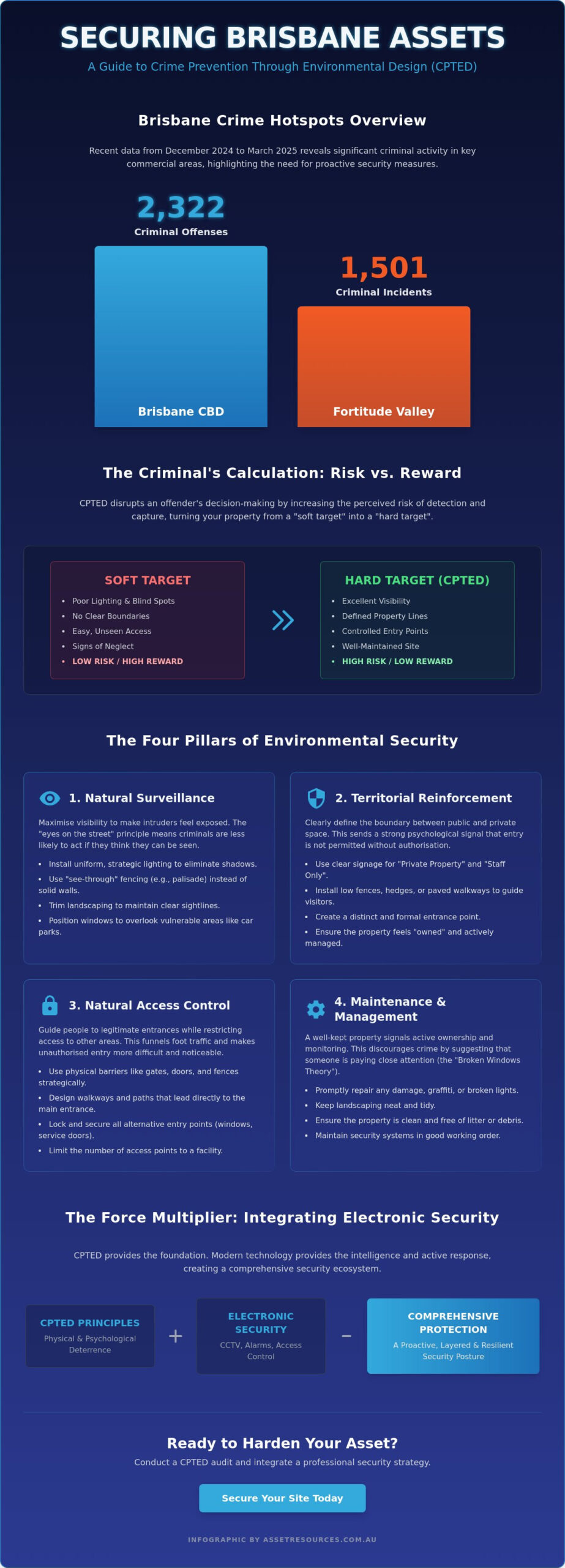
Between December 2024 and March 2025, Brisbane’s CBD recorded 2,322 criminal offenses, while Fortitude Valley saw over 1,501 incidents. These figures highlight a harsh reality for local asset managers; traditional locks and fences aren’t always enough to deter determined intruders. You likely want a secure facility that protects your team and assets without making your site look like a high-security prison. Balancing aesthetic appeal with robust protection is a common struggle, especially when you’re trying to decipher complex QLD guidelines while facing pressure from recurring vandalism or trespassing.
In this guide, you’ll discover how to secure your property by combining strategic crime prevention through environmental design with professional electronic security systems. We’ve built this approach on pragmatic realism to help you harden your property effectively and meet regulatory standards. We will cover the core CPTED principles, provide actionable steps to reduce vulnerability, and show you how to integrate modern technology like CCTV and access control into your physical design. By the end, you’ll have a clear roadmap to create a safer, more resilient environment that works for your business and your budget.
Key Takeaways
- Understand how criminals evaluate risk versus reward and how smart environmental design disrupts their decision-making process.
- Master the four pillars of crime prevention through environmental design to naturally deter intruders using visibility and clear territorial boundaries.
- Discover how to bridge the gap between physical layout and electronic intelligence by integrating professional CCTV and access control systems.
- Identify specific strategies for hardening high-risk Brisbane assets, ranging from remote industrial perimeters to high-traffic retail storefronts.
- Get a practical framework for conducting a site risk assessment and mapping a new security strategy against your current physical layout.
What is Crime Prevention Through Environmental Design (CPTED)?
At its core, Crime Prevention Through Environmental Design (CPTED) is a multi-disciplinary strategy focused on deterring criminal behavior by modifying the built environment. It isn’t just about adding more locks or taller fences. Instead, it examines how the physical layout of a site can influence human behavior to reduce the likelihood of crime. In Brisbane’s industrial and corporate sectors, this approach has evolved into the “Safer by Design” standard for 2026. This ensures that security is integrated into the architecture from the start rather than being a costly, reactive afterthought.
The philosophy rests on a pragmatic understanding of criminal intent. Most offenders are rational actors who perform a quick mental calculation of risk versus reward before they strike. If a property looks like a difficult target where detection is likely, they’ll usually move on to an easier opportunity. By manipulating environmental variables like lighting, sightlines, and access points, you can tilt this calculation in your favor. For many new developments across South East Queensland, incorporating these principles is no longer optional. The Brisbane City Plan includes specific CPTED planning policies that developers must satisfy to secure project approval and ensure long-term community safety.
The Psychology of the Offender
Criminals look for “soft targets” where they can operate without being noticed. CPTED uses environmental cues to signal that a property is a “hard target.” This involves removing any “excuses” for a person to be in a restricted area. If a site has clear boundaries, well-maintained landscaping, and obvious surveillance, an intruder knows they’re being watched. The perceived risk of detection is the most powerful deterrent you have. When a site feels “owned” and active, it creates a psychological barrier that is often more effective than a physical one.
CPTED Guidelines for Queensland
The Queensland Police Service and state government provide comprehensive guidelines that define how these principles apply locally. These standards aren’t just for public parks; they’re essential for commercial and industrial asset protection. Following these guidelines moves your security posture from reactive to proactive. Rather than just responding to a break-in after it happens, you’re managing the environment to prevent the incident from occurring. Key elements of the QLD framework include:
- Surveillance: Maximizing visibility so that intruders feel exposed to “eyes on the street.”
- Access Control: Using physical and symbolic barriers to direct people to legitimate entry points.
- Territoriality: Clearly defining the transition from public space to private property.
- Maintenance: Demonstrating that the property is cared for, which signals active management and monitoring.
The Four Pillars of Environmental Security
Implementing effective security isn’t about guesswork. It requires a structured framework that turns your property into a difficult target for intruders. By utilizing the CPTED problem-solving process, asset managers can address vulnerabilities through four specific pillars. These pillars work together to create a cohesive defense that relies on both physical design and psychological deterrence. When these elements are balanced, your facility becomes inherently safer without sacrificing operational efficiency.
Maximising Natural Surveillance
Natural surveillance is the strategic placement of physical features to ensure maximum visibility. The goal is to ensure that any intruder feels exposed to potential witnesses at all times. This starts with eliminating blind spots created by poorly placed fences or dense shrubbery. For example, maintaining “see-through” fencing like chain wire or palisade allows for clear sightlines while still providing a physical barrier. Strategic lighting is equally vital. It’s not just about brightness; it’s about uniformity to ensure there are no dark pockets where someone can hide. Well-placed windows in office blocks overlooking car parks further enhance this “eyes on the street” effect, making detection a constant threat for criminals.
Establishing Territorial Reinforcement
Territorial reinforcement is about signaling ownership and authority. It clearly distinguishes between public thoroughfares and your private industrial space. You can achieve this through clear signage, distinct pavement textures, or even subtle changes in landscaping. When a boundary is well-defined, it removes the “excuse” for casual trespassing. For Brisbane businesses, a well-defined perimeter is the first line of defense. It tells an intruder exactly where they don’t belong. If you’re unsure if your current layout provides enough of a deterrent, professional security consulting can help identify where your boundaries are failing.
The remaining pillars focus on movement and upkeep. Natural access control uses hedges, gates, and paths to guide people toward legitimate entry points, making unauthorized access stand out immediately. Maintenance and management apply the “Broken Windows” theory to modern assets. A property with graffiti, broken lights, or overgrown weeds signals neglect. To a criminal, neglect suggests that security is likely lax and no one is watching. Keeping your site in top condition isn’t just about pride; it’s a critical component of crime prevention through environmental design that tells the world your site is actively managed and protected.
Integrating Technology: Where CPTED Meets Electronic Security
Physical design provides the skeleton for a secure site, but for high-value industrial and corporate assets, it’s rarely sufficient. While natural surveillance depends on clear sightlines and human presence, it’s inherently limited by lighting conditions and staffing hours. Integrating electronic intelligence with crime prevention through environmental design transforms a passive layout into an active, 24/7 security ecosystem. Technology doesn’t replace the four pillars; it reinforces them by providing organised surveillance and rigid entry management that physical design cannot achieve alone.
The primary advantage of electronic systems is their ability to maintain the “eyes on the street” philosophy when no one is actually on the street. In Brisbane’s industrial zones, where warehouses often sit empty overnight, technology provides the continuity required to protect high-value inventory. It bridges the gap between the architectural intent of a building and its actual operational security performance.
CCTV as a Force Multiplier
Natural surveillance fails in the dark or in remote corners of a large warehouse property. Professional cctv installation brisbane acts as a force multiplier by covering these critical gaps. Modern 2026 systems utilize AI-powered analytics to detect loitering, identify license plates, or track specific objects in real time. This moves your security posture from a reactive “review the footage” model to a proactive alert system. When cameras are integrated with motion-activated perimeter lighting, they create a formidable deterrent. An intruder who might ignore a physical sign will think twice when a floodlight illuminates them and a camera follows their every move.
Electronic Access Control and Intercoms
The CPTED pillar of natural access control uses physical cues to guide people. However, access control systems provide the hard data and enforcement needed for high-stakes environments. Replacing physical keys with trackable mobile credentials or fobs ensures that every entry is logged and unauthorized attempts are flagged immediately. This is essential for Brisbane businesses managing multiple shifts or high staff turnover where physical key management is a liability.
Intercom systems further support this by providing visitor verification at the primary entry point. This ensures the “Natural Access Control” pillar is never compromised by a tailgating incident or a simple oversight. By pairing access control systems brisbane with integrated intruder alarms, you establish a level of territorial reinforcement that physical design cannot match. You aren’t just suggesting that a space is private; you’re electronically enforcing its boundaries. This synergy between the physical environment and electronic hardware creates a site that is not only “Safer by Design” but also operationally resilient.
Applying CPTED to Brisbane Commercial and Industrial Sites
Brisbane’s industrial landscape is diverse, ranging from the high-density hubs of Eagle Farm to the sprawling perimeters of Acacia Ridge and Pinkenba. Each site presents unique vulnerabilities that require more than a one-size-fits-all security plan. A common objection among asset managers is that crime prevention through environmental design is an expensive luxury. In reality, the ROI is found in reduced inventory loss, lower insurance premiums, and a decreased reliance on constant physical presence. By designing out crime from the start, you create a self-sustaining security environment that protects your high-value professional assets without inflating your overheads.
For retail storefronts in high-traffic areas like Fortitude Valley, the challenge is balancing an inviting customer experience with effective theft prevention. This is achieved through “activation,” ensuring that shop layouts maintain clear sightlines from the street to the register. In multi-tenant office blocks, the focus shifts to managing shared common areas and lobbies. Using electronic systems to enforce territorial boundaries ensures that only authorized personnel move between floors, keeping your workforce safe and your data secure.
Securing Industrial Perimeters in South East QLD
Large industrial sites often struggle with remote boundaries and hidden loading bays. Effective CPTED for these areas involves using see-through fencing that provides a physical barrier without creating blind spots for your surveillance systems. Loading docks should remain clear of stacked pallets or equipment that could serve as hiding spots or climbing aids. While environmental design does the heavy lifting, it’s vital to have a contingency plan. Integrating emergency response support ensures that if your physical perimeters are tested, you have a professional backup ready to act.
Lighting Strategies for Brisbane Businesses
Many business owners assume that more light equals better security, but poorly planned lighting can actually help an intruder. High-intensity floodlights often create deep shadows and glare, which can blind both witnesses and CCTV cameras. The goal is uniform, low-glare lighting that eliminates dark pockets. Motion-activated lighting is particularly effective in industrial zones because the sudden change in environment startles intruders and serves as a visual signal for mobile patrols or neighbors that something is wrong. Modern LED solutions also help you meet Brisbane City Council sustainability requirements while maintaining peak operational security.
If you are ready to harden your property against local threats, contact our team today for a comprehensive security consultation tailored to your specific site requirements.
Implementing a CPTED Audit and Security Strategy
Transitioning from the theory of crime prevention through environmental design to a hardened, secure site requires a methodical execution plan. You can’t simply install a few cameras and hope for the best. A professional strategy ensures that every modification, from the height of a hedge to the placement of a sensor, serves a specific defensive purpose. This process bridges the gap between architectural intent and operational reality, providing a clear path for Brisbane asset owners to protect their investments without unnecessary expenditure.
To implement an effective CPTED strategy, follow these five essential steps:
- Step 1: Conduct a site risk assessment. Identify existing vulnerabilities by walking your perimeter. Look for signs of unauthorized access, such as cut fences or graffiti, and note areas with poor lighting or obscured sightlines.
- Step 2: Map the four pillars against your layout. Evaluate how your current physical environment supports or hinders natural surveillance, territorial reinforcement, access control, and maintenance.
- Step 3: Identify hardware gaps. Determine where your physical environment cannot meet security needs. If a remote corner of your warehouse remains hidden from view despite landscaping changes, this is where electronic hardware must fill the gap.
- Step 4: Create a phased implementation plan. Prioritize high-impact changes like upgrading entry point lighting and access control before moving to secondary aesthetic or landscaping modifications. This helps manage budgets while addressing immediate risks.
- Step 5: Establish regular maintenance. Ensure the “management” pillar remains strong by fixing broken lights, repairing fences immediately, and keeping the site clean. A neglected site is an invitation to intruders.
The Professional Security Audit
While some property managers attempt a DIY assessment, partnering with experienced security firms brisbane is essential for a comprehensive audit. Government-led audits are often delayed by backlogs, but a private consultant provides a technical, result-oriented evaluation of your specific risks. These professionals focus on the synergy between your alarm systems brisbane and your physical barriers to eliminate any single point of failure. A CPTED audit should be reviewed annually to adapt to changing local crime trends and ensure your defenses remain current with 2026 technology standards.
Next Steps: Securing Your Asset
Asset Resources Group integrates CPTED principles into every installation we perform across South East Queensland. We believe in a pragmatic, no-nonsense approach to industrial security that values long-term reliability over temporary fixes. Our team works as a collaborator to ensure your electronic systems and physical environment work in total harmony to protect your workforce and professional assets. Ready to harden your site? Contact Asset Resources Group for a professional security consultation today.
Future-Proof Your Brisbane Asset Protection
Securing a commercial or industrial site in South East Queensland requires a strategy where physical layout and electronic systems work in tandem. By applying the principles of crime prevention through environmental design, you move from a reactive security posture to a proactive one that naturally deters criminal intent. This approach ensures that your facility remains safe while maintaining the operational flow your business needs to thrive.
Since 2016, Asset Resources Group has operated as an Australian-owned specialist in Brisbane commercial and industrial security. We provide expert integration of CCTV and access control systems designed to reinforce your site’s physical defenses. Our team understands the pragmatic requirements of regional industrial environments and delivers the technical excellence necessary to protect your high-value professional assets. Secure your Brisbane business with a CPTED-aligned security solution from Asset Resources Group.
Taking these steps today creates a resilient environment for your workforce and your property. With the right combination of design and technology, you can maintain a secure, professional site that stands up to the evolving challenges of the local landscape.
Frequently Asked Questions
What is the main goal of Crime Prevention Through Environmental Design?
The primary objective of crime prevention through environmental design is to reduce the opportunity for criminal activity by strategically modifying the built environment. It aims to influence offender behavior by increasing the perceived risk of detection and making the effort required to commit a crime outweigh the potential reward. By creating spaces that feel supervised and controlled, you establish a psychological deterrent that stops many incidents before they occur.
Does CPTED actually work in reducing commercial crime?
CPTED is highly effective because it addresses the root environmental factors that attract criminals to specific sites. When a property owner implements natural surveillance and territorial reinforcement, they significantly increase the likelihood that an intruder will be noticed. Industry data and urban planning studies consistently show that well-maintained environments with clear sightlines experience fewer incidents of vandalism and trespassing compared to neglected or poorly designed properties.
Is CPTED a legal requirement for new developments in Brisbane?
Yes, CPTED principles are integrated into the Brisbane City Plan through specific planning scheme policies. For many new commercial, industrial, or high-density residential developments, submitting a formal CPTED assessment is a mandatory part of the development application process. These guidelines ensure that new projects contribute to community safety and don’t create vulnerabilities that could lead to increased crime rates in the surrounding area.
How does lighting affect CPTED and property security?
Lighting serves as a critical tool for natural surveillance by eliminating dark zones where intruders can hide. Effective security lighting isn’t just about high-intensity brightness; it requires uniform coverage to avoid deep shadows and glare that can blind witnesses or obscure CCTV footage. Motion-activated lights are especially useful for startling intruders and signaling that a property is actively managed and monitored after hours.
What is the difference between target hardening and CPTED?
Target hardening focuses on physical barriers like high-quality locks, reinforced doors, and intruder alarms to stop an offender once they reach an entry point. CPTED is a broader strategy that uses the design of the entire site to prevent the offender from approaching that entry point in the first place. While target hardening is an essential component of a secure facility, CPTED creates an environment that makes the property look like a difficult, high-risk target from the perimeter.
Can CPTED principles be applied to existing buildings, or only new ones?
CPTED principles are highly adaptable and can be retrofitted to existing buildings just as effectively as they’re designed into new ones. Business owners can improve their security posture by thinning out dense landscaping, upgrading to smart LED lighting, or installing modern access control systems. A professional security audit can identify quick, cost-effective environmental changes that harden an older facility against modern threats without requiring a complete rebuild.
How do CCTV cameras fit into a CPTED strategy?
CCTV cameras act as “organised surveillance” within a crime prevention through environmental design framework, filling gaps where natural sightlines are blocked. They provide a continuous record of activity and monitor remote perimeters that aren’t visible from the main building. Integrating high-definition cameras with environmental design ensures that if an intruder ignores the psychological deterrents of your layout, their actions are captured and identified immediately.
What are the most common CPTED mistakes business owners make?
The most common mistake is creating “entrapment spots” with high, solid fences or dense shrubbery that actually hide criminal activity from the street. Another major error is neglecting site maintenance; broken lights or overgrown weeds signal that the property isn’t actively managed, which invites trouble. Finally, many owners fail to integrate electronic security systems, relying solely on physical design which leaves the property vulnerable during low-traffic overnight hours.