Internal theft accounts for 28% of retail losses in Queensland, a figure that now exceeds shoplifting and break-ins combined. While many business owners focus on external threats, staying ahead of local crime requires a firm grasp of the latest Brisbane retail store CCTV requirements to ensure your surveillance is both legal and effective. It’s common to feel frustrated by the gap between general retail laws and licensed venue regulations, or to worry about the legal fallout of a privacy breach.
You need a system that provides clear, actionable evidence rather than grainy footage that fails when you need it most. This guide details how to master the legal, technical, and strategic requirements for your business to ensure full compliance and maximum asset protection. We’ll walk through mandatory licensing standards, the 2026 shift toward AI-driven IP systems, and the critical privacy laws that dictate how you record and store footage in the Brisbane region.
Key Takeaways
- Distinguish between general Queensland laws and specific Brisbane City Council mandates for licensed venues trading past 1am.
- Identify the technical benchmarks for 2026, including why 4K resolution and 28-day footage retention are essential for usable evidence.
- Ensure full compliance with Brisbane retail store CCTV requirements regarding mandatory signage and the Invasion of Privacy Act.
- Optimize your camera layout to eliminate blind spots in high-shrinkage zones and capture clear transaction details at the point-of-sale.
- Learn how to integrate surveillance with intruder alarms and access control to create a unified, proactive security network.
Navigating Brisbane Retail CCTV Regulations: Mandatory vs. Recommended
Compliance isn’t just a hurdle. For Brisbane business owners, it’s the foundation of a secure operation. While every shop in the CBD or suburbs needs protection, the specific Brisbane retail store CCTV requirements vary significantly depending on what you sell and when you close your doors. The distinction between Brisbane City Council (BCC) mandates and general Queensland law often catches managers off guard, leading to system gaps that only become apparent after an incident occurs.
Under the Work Health and Safety Act, you have a fundamental duty of care to protect your workforce and patrons. This legal obligation implies that if a foreseeable risk exists, you must take reasonable steps to mitigate it. In a high-traffic retail environment, a functioning surveillance system is rarely considered optional by insurers or legal counsel. A foundational understanding CCTV technology and its legal application is essential for any business owner in the River City. By 2026, police investigators expect more than just grainy footage. They require high-speed digital copy production that can be easily exported and analyzed without proprietary software hurdles.
Requirements for Licensed Retail and Late-Night Venues
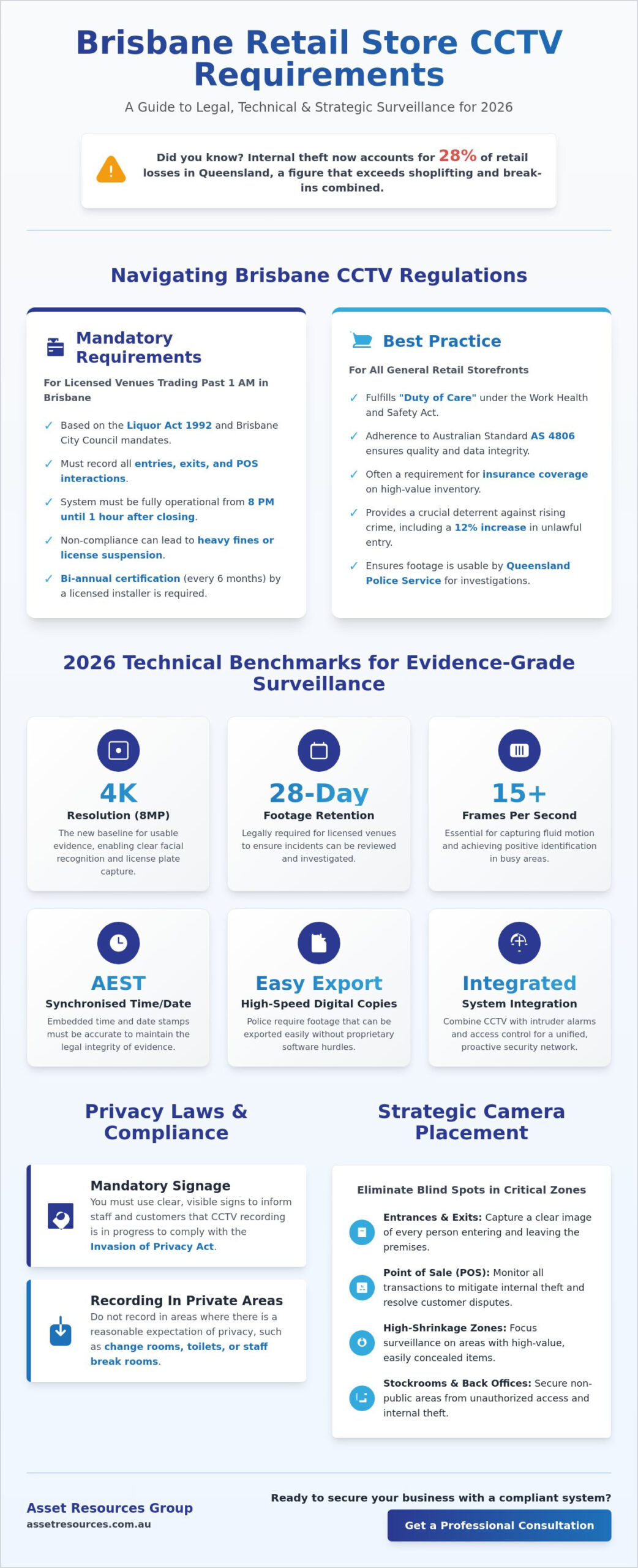
If your retail business holds a liquor license and trades past 1 am within the Brisbane City Council area, your obligations shift from best practice to strict mandate. The Liquor Act 1992 and associated regulations are clear. Your system must record all entries and exits, as well as every interaction at the point of sale. These systems must be fully operational from 8 pm until at least one hour after you close. Failing to maintain an operative system after 1 am can result in heavy fines or the suspension of your license. Brisbane licensees are also required to have their equipment certified by a licensed installer every six months to ensure the evidence remains admissible in court.
Best Practice for General Brisbane Storefronts
Most retailers don’t fall under late-night liquor mandates, but they still face escalating risks. The Queensland Police Service reported a 12% increase in unlawful entry attempts in Brisbane commercial zones in 2025. For these businesses, adhering to the Australian Standard AS 4806 ensures your system meets professional benchmarks for image quality and data integrity. Insurance providers often demand these standards are met before they’ll cover high-value inventory. Designing a system that reflects local crime trends in your specific suburb, whether that’s Chermside or Mount Gravatt, ensures your investment actually stops losses instead of just recording them. Meeting Brisbane retail store CCTV requirements isn’t about ticking a box. It’s about building a resilient asset protection strategy.
Technical Specifications for Evidence-Grade Surveillance
Capturing an event on camera means very little if the footage doesn’t meet the evidentiary standards required by the Queensland Police Service (QPS). In 2026, 4K (8MP) resolution has moved from a luxury to a baseline necessity for meeting Brisbane retail store CCTV requirements. High-definition systems that once seemed adequate often fail to provide the granular detail needed for facial recognition or reading license plates in a crowded car park. If your system can’t produce a clear image of a suspect’s features, your investment provides a false sense of security rather than a viable deterrent.
Technical compliance also extends to the metadata behind the video. All surveillance systems must have embedded time and date stamps synchronised with Australian Eastern Standard Time (AEST). If your system clock drifts by even a few minutes, the integrity of your evidence can be challenged in court. For licensed venues in the Brisbane City Council area, the law is even more specific. You’re required to maintain a 28-day retention period for all footage. Additionally, these systems must undergo a professional certification check every six months to ensure they remain fully operational. This rigorous maintenance schedule prevents the common disaster of discovering a hard drive failure only after a major theft has occurred. Reviewing the Queensland Government CCTV guide provides further clarity on these legal benchmarks for business owners.
Frame Rates and Image Clarity Standards
Effective surveillance relies on the distinction between detection, recognition, and identification. Detection tells you someone is there; identification provides enough detail for a positive ID in a lineup. To achieve this at high-traffic entry points, you need a frame rate of at least 15 to 25 frames per second (fps). Lower frame rates result in motion blur, making fast-moving incidents impossible to analyse. Brisbane storefronts also face unique lighting challenges. Wide Dynamic Range (WDR) and low-light technologies like ColorVu are essential for managing the harsh glare of the Queensland sun reflecting off glass windows, ensuring your footage remains balanced and clear throughout the day.
Storage and Data Integrity
Recording 4K video for 28 days requires significant storage capacity. Network Video Recorders (NVRs) are the industry standard for managing these high-bandwidth streams while maintaining data integrity. When an incident occurs, you must be able to export digital copies quickly in a format compatible with QPS systems. Relying on proprietary players that require complex installations can delay investigations. Modern NVRs allow for seamless exports to USB or secure cloud links, ensuring your response is as fast as the incident itself. If you’re unsure if your current setup meets these benchmarks, you can upgrade your CCTV surveillance systems to ensure 2026 compliance. Meeting Brisbane retail store CCTV requirements ensures your business stays protected and legally sound.
Privacy Laws and Mandatory Signage in Queensland
Installing high-end hardware is only half the battle for asset protection. If your system violates the Invasion of Privacy Act 1971 or the Privacy Act 1988, the footage you’ve gathered may be legally worthless in a court of law. Meeting Brisbane retail store CCTV requirements involves a careful balance between security needs and the privacy rights of both customers and staff. Ignoring these legal boundaries doesn’t just risk a fine; it can lead to criminal charges if audio or video is captured in prohibited areas.
Audio recording is a particularly sensitive area in Queensland. It’s generally a criminal offense to record private conversations without the consent of all parties involved. Most commercial CCTV cameras feature built-in microphones, but we recommend disabling these by default. Unless you’ve obtained specific legal counsel and displayed explicit warnings that include audio capture, recording sound can lead to severe legal complications. Similarly, staff privacy must be respected. While you can monitor stockrooms and loading docks, you must never install cameras in bathrooms, changing rooms, or any area where a person has a reasonable expectation of privacy. Transparent communication with your workforce about camera locations in back-of-house areas helps maintain a professional, high-value relationship with your team.
Signage Placement and Wording
Signs serve as the legal mechanism for “implied consent.” When a person sees a surveillance notice and chooses to enter, they’re legally agreeing to be recorded. To be effective, these signs must be prominent and clearly visible before a person enters the monitored zone. While there isn’t a strictly mandated size, an A4-sized sign is the industry recommendation for main entrances. Queensland law requires that CCTV signage must be clearly visible and legible at every public point of entry to establish implied consent for surveillance. Your signs should clearly state that 24-hour surveillance is in operation and provide a point of contact for the business.
Footage Access and Data Privacy
Data security is a core component of modern Brisbane retail store CCTV requirements. Only authorized personnel, such as the store manager or a designated security officer, should have the credentials to view live feeds or export recordings. You should maintain a CCTV equipment review register to document every time footage is accessed, why it was viewed, and who authorized the session. This audit trail is invaluable during compliance checks or when responding to “Right to Information” requests from the public. Securely storing your NVR in a locked rack or restricted office ensures that your evidence remains untampered and ready for police review if an incident occurs.
Strategic Camera Placement for Maximum Store Coverage
Strategic camera placement turns a basic surveillance system into a formidable asset protection tool. Simply mounting a camera in a corner rarely satisfies the operational needs of modern businesses or the technical Brisbane retail store CCTV requirements for evidence-grade footage. To achieve “Face ID” quality, entry cameras should be mounted at eye level, approximately 1.6 to 1.7 metres, rather than high on a ceiling. This angle captures features under a hat or hoodie, which is often impossible with traditional top-down views. It ensures that the first point of contact provides the highest quality identification data for police review.
Point-of-Sale (POS) monitoring is equally critical. Given that internal theft accounts for 28% of retail losses in Queensland, cameras must be positioned to capture both the cash drawer and the customer’s hands. High-resolution sensors allow you to zoom in on specific transaction details or currency denominations without losing clarity. Beyond the shop floor, loading docks and external perimeters require robust coverage to deter after-hours unlawful entries. These areas are frequently targeted under the cover of darkness, making high-performance night vision sensors a non-negotiable requirement for Brisbane commercial zones.
Entry and Exit Point Optimisation
Your entry points are your first line of defense. Using specific focal lengths ensures that every person entering the building is captured with enough detail for a positive identification. Brisbane’s intense sunlight creates significant counter-light challenges at glass storefronts. Without Wide Dynamic Range (WDR) sensors, subjects often appear as dark silhouettes against a bright background. For a truly unified security posture, many businesses are now linking their entry cameras to Access Control Systems Brisbane. This integration allows you to visually verify every individual who uses a credential to enter restricted zones, creating a dual layer of verification that protects your premises.
Internal Floor Management
Effective floor management requires eliminating blind spots in high-shrinkage zones, particularly near fitting room entries. While you cannot record inside private areas, monitoring the approach is a key part of Brisbane retail store CCTV requirements for effective loss prevention. High-value inventory displays benefit from specialized varifocal lenses. These allow you to adjust the field of view to focus strictly on the assets. Comprehensive coverage must also extend to stockrooms and staff-only zones. This ensures that the movement of high-value professional assets is tracked from the moment of delivery until the final sale. If your current layout leaves your inventory exposed, it is time to invest in professional CCTV surveillance systems to secure your operational environment.
The ARG Advantage: Integrated Retail Security Solutions
A standalone camera system is a passive observer. In the 2026 security landscape, Brisbane retailers need a proactive shield. Meeting the baseline Brisbane retail store CCTV requirements is the start, but a truly resilient operation links surveillance with other critical hardware. When your cameras communicate with Alarm Systems Brisbane, you move from recording a crime to interrupting one. This unified approach ensures that a triggered sensor immediately flags the relevant video feed, allowing for rapid verification and response. It transforms your security from a forensic tool into a preventative asset.
Professional CCTV Installation Brisbane provides more than just tidy cabling. It offers a documented trail of professional risk mitigation that insurance providers value when calculating premiums. For licensed venues, the legal requirement for a six-monthly system certification isn’t just a hurdle; it’s an opportunity to ensure your hardware hasn’t succumbed to the humid Queensland climate or local environmental wear. Ongoing technical support keeps your system in peak condition, ensuring that when the police request footage, your NVR delivers evidence-grade files without delay. We treat your security infrastructure as a high-value professional asset that demands expert oversight.
Seamless System Integration
Perimeter security is most effective when it’s layered. By integrating CCTV with intruder alarms and intercoms, you create a synchronized network that monitors every point of vulnerability. Remote monitoring has become a standard expectation for modern managers, allowing you to access live feeds from any location via a secure mobile interface. This capability is particularly vital for business owners managing multiple sites across the Brisbane region. Regular Security Camera Inspection Brisbane prevents the silent failures that often plague unmaintained systems, such as lens obscuration or hard drive degradation. This procedural excellence ensures your security assets are always ready for deployment.
Expert Consultation and Local Knowledge
Every retail niche faces distinct threats. A high-end jewelry store in the CBD requires different focal lengths and sensor sensitivities than a liquor outlet in the outer suburbs. We specialize in customizing security designs that reflect these specific operational environments while navigating local council permits and heritage building restrictions common in older Brisbane precincts. Adhering to Brisbane retail store CCTV requirements requires a partner who understands the local regulatory and industrial landscape. Our team works as a collaborator to ensure your system meets the legal floor and the operational ceiling. You can book a professional site assessment with Asset Resources Group to ensure your store is fully compliant and strategically protected for the years ahead.
Future-Proofing Your Brisbane Retail Assets
Managing a retail operation in 2026 demands more than just a passing interest in security. It requires a commitment to meeting strict Brisbane retail store CCTV requirements to ensure your evidence is admissible and your premises are protected. From mastering the 28-day retention mandates for late-night venues to optimizing camera heights for facial identification, the technical landscape is complex but manageable with the right strategy.
Integrating your surveillance with intruder alarms and access control creates a unified defense that standalone systems simply can’t match. As Licensed Queensland Security Providers and BCC compliance experts, Asset Resources Group specializes in integrated retail technology. We ensure your system isn’t just a recording device, but a proactive tool for risk mitigation and insurance premium management.
Don’t leave your compliance to chance. Request a Professional CCTV Compliance Audit for Your Brisbane Store today to verify your system meets every local standard. Protecting your workforce and your inventory starts with a reliable, expert-designed security foundation.
Frequently Asked Questions
How long am I legally required to keep CCTV footage in Queensland?
Licensed venues trading past 1 am in the Brisbane City Council area are legally required to store footage for a minimum of 28 days. If an incident is under active investigation, police may require you to hold that specific data for up to one year. For general retailers, while there isn’t a strictly mandated timeframe, maintaining 28 days of high-resolution recording is the industry standard for insurance and evidence integrity.
Do I need to display signs if I have security cameras in my Brisbane shop?
You’re legally required to display clear and prominent signage at every entrance to areas under surveillance. This notice informs entrants that they’re being recorded, which establishes the legal basis of implied consent under the Privacy Act. While specific dimensions aren’t dictated by law, using A4-sized signs at main entry points ensures you meet the “clearly visible” requirement for public notice.
Is it legal to record audio in my retail store?
Recording audio is generally prohibited in Queensland retail environments without the express consent of all parties. The Invasion of Privacy Act 1971 makes it a criminal offense to record private conversations without a warrant or specific legal exemption. It’s best practice to disable camera microphones entirely to avoid accidental breaches of privacy law that could lead to criminal charges or civil litigation.
What happens if my CCTV system malfunctions after 1am in a licensed venue?
A malfunction after 1 am in a licensed venue can lead to immediate liquor license penalties or significant fines. The law requires these systems to be fully operational during the mandatory window from 8 pm until one hour after closing. Regular maintenance by a licensed professional is the only way to ensure your system doesn’t fail during these critical hours, protecting both your license and your patrons.
Can I install my own retail security cameras, or do I need a licensed professional?
You must use a licensed professional for any security camera installation in Queensland. Any individual or business installing security equipment must hold a current Security Licence issued by the Queensland Police Service. Additionally, any cabling hidden in walls or ceilings requires an installer with an Open Cabler Registration to stay compliant with Australian wiring rules and ensure your insurance remains valid.
Who is allowed to view my store’s CCTV recordings under Queensland law?
Only authorized staff and police officers are permitted to view your surveillance footage. You’re responsible for protecting this data and ensuring it isn’t accessed by unauthorized third parties or leaked to the public. Keeping a detailed access log or review register helps you demonstrate compliance during a privacy audit or police inquiry, ensuring your business handles personnel and customer data as high-value professional assets.
How often do I need to have my retail CCTV system serviced and certified?
Licensed venues must have their systems certified by a professional every six months to remain compliant with their liquor license. For other businesses, this same six-month interval is the recommended benchmark for meeting Brisbane retail store CCTV requirements. Regular servicing prevents hardware failure and ensures your system remains capable of producing evidence-grade footage that stands up in a court of law when you need it most.
What technical specifications does the Queensland Police Service require for footage?
The Queensland Police Service requires clear, high-resolution digital copies that include accurate time and date stamps synchronized with AEST. By 2026, 4K resolution is the expected standard for identifying suspects in a retail environment. Your system must also allow for quick export to a USB or cloud link in a format that doesn’t require specialized software, ensuring your setup meets all Brisbane retail store CCTV requirements.