Approximately 40% of reported assaults in Australia occur within entertainment precincts, making your surveillance strategy the difference between a safe night and a $15,480 non-compliance penalty. For Brisbane licensees, managing massive crowds and sprawling floor plans involves more than just mounting cameras. It’s about eliminating blind spots and meeting the strict standards of the Liquor Act 1992. You understand that high liability risks and the difficulty of managing temporary staff require a pragmatic, safety-first approach to event venue CCTV installation Brisbane.
We agree that your security hardware should be an active asset for real-time crowd mobilisation, not just a passive hard drive gathering dust. This 2026 checklist promises a comprehensive look at planning and installing professional-grade systems that protect your patrons and your bottom line. You’ll learn how to ensure full venue visibility, comply with mandatory 28-day digital storage regulations, and use high-quality evidence to reduce insurance premiums. We also preview the latest AI analytics and the required six-monthly technical audits to keep your venue running safely and legally.
Key Takeaways
- Understand why standard commercial setups fail in high-movement crowds and how to implement a high-density surveillance strategy for public safety.
- Master the 5-zone layout strategy to fulfill your legal “Duty of Care” while ensuring total coverage across massive venue footprints.
- Identify the specific hardware requirements, such as PTZ tracking and 360-degree fisheye cameras, needed for professional event venue CCTV installation Brisbane.
- Ensure your venue meets the QLD Security Providers Act 1993 requirements and follows mandatory signage protocols for public surveillance.
- Discover how a structured mobilisation workflow bridges the gap between technical hardware and on-site security teams for superior venue protection.
Why Event Venue CCTV Installation in Brisbane Requires a Specialized Approach
Standard commercial security setups often focus on simple theft deterrence. While a basic four-camera system might work for a small retail shop, it inevitably fails in high-movement environments like Suncorp Stadium or the Fortitude Valley entertainment precinct. Effective event venue CCTV installation Brisbane requires a high-density surveillance strategy. This means deploying a network that prioritises public safety and real-time situational awareness over simple recording. Venue managers need to see every corner of a crowd to identify potential bottlenecks or escalating conflicts before they turn into police incidents.
The shift toward high-definition IP (Internet Protocol) systems has changed the game for evidentiary quality. Under the Liquor Act 1992, Brisbane venues trading past 1:00 AM must provide clear footage for at least 28 days. Standard analogue systems often lack the resolution needed to identify individuals in a dark, crowded room. Modern IP cameras provide the clarity required to protect your assets and your license. We focus on a “Need – Expertise – Result” workflow to ensure your hardware meets these rigorous standards from the day of mobilisation.
The Difference Between Passive Recording and Active Surveillance
Passive recording is a post-event luxury that venue managers can’t afford. In high-stakes environments, surveillance must be an active asset. Most people understand the basics of what is CCTV, but in a venue setting, it must be integrated with your ground team. Real-time monitoring allows operators to direct mobile patrols to specific zones the moment a disturbance begins. High-frame-rate cameras are non-negotiable here. While regulations require a minimum of six frames per second, we recommend much higher rates to capture fast-moving incidents without motion blur. This level of detail is critical for emergency response support, giving first responders the exact visual data they need during a crisis.
Brisbane-Specific Venue Challenges
Our local climate presents unique hurdles for hardware longevity. South East Queensland’s intense humidity and sudden summer storms can wreck standard indoor-rated cameras. Outdoor installations at sites like the RNA Showgrounds require IP66 or IP67-rated enclosures to prevent moisture ingress. Managing extreme glare during afternoon events is another challenge. We utilise cameras with Wide Dynamic Range (WDR) to handle the transition from bright sunlight to deep shadows in open-air venues. Finally, we ensure wireless stability. In environments where thousands of patrons are using mobile data, our systems use dedicated, interference-resistant frequencies to maintain a constant feed to the control room.
The Ultimate Event Security Checklist: Planning Your CCTV Layout
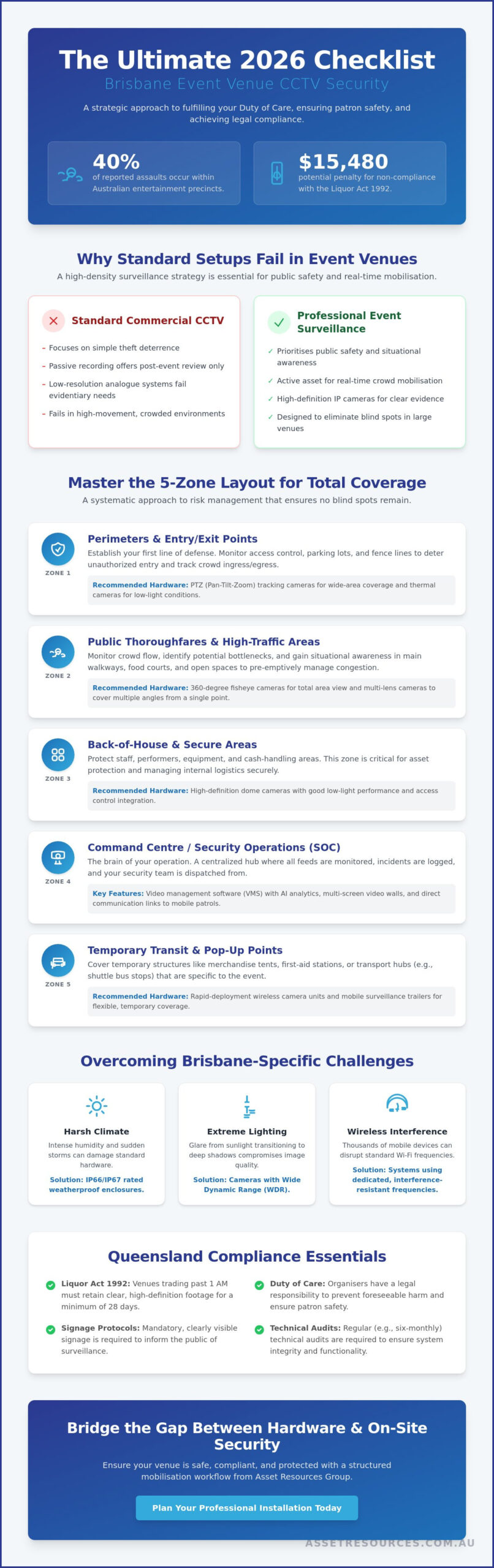
Planning a layout for a major event isn’t just about sticking cameras on poles. It’s a systematic approach to risk management. Under Queensland law, organisers have a strict “Duty of Care” to ensure patron safety and prevent foreseeable harm. This responsibility starts with a robust event venue CCTV installation Brisbane strategy that covers every square metre of the site. We recommend a 5-zone surveillance strategy that encompasses perimeters, public thoroughfares, back-of-house areas, the command centre, and temporary transit points. This structured framework ensures no “blind spots” remain where liability or safety risks can hide. Pairing this surveillance strategy with crime prevention through environmental design principles allows venue managers to address security vulnerabilities at the physical layout level before a single camera is mounted.
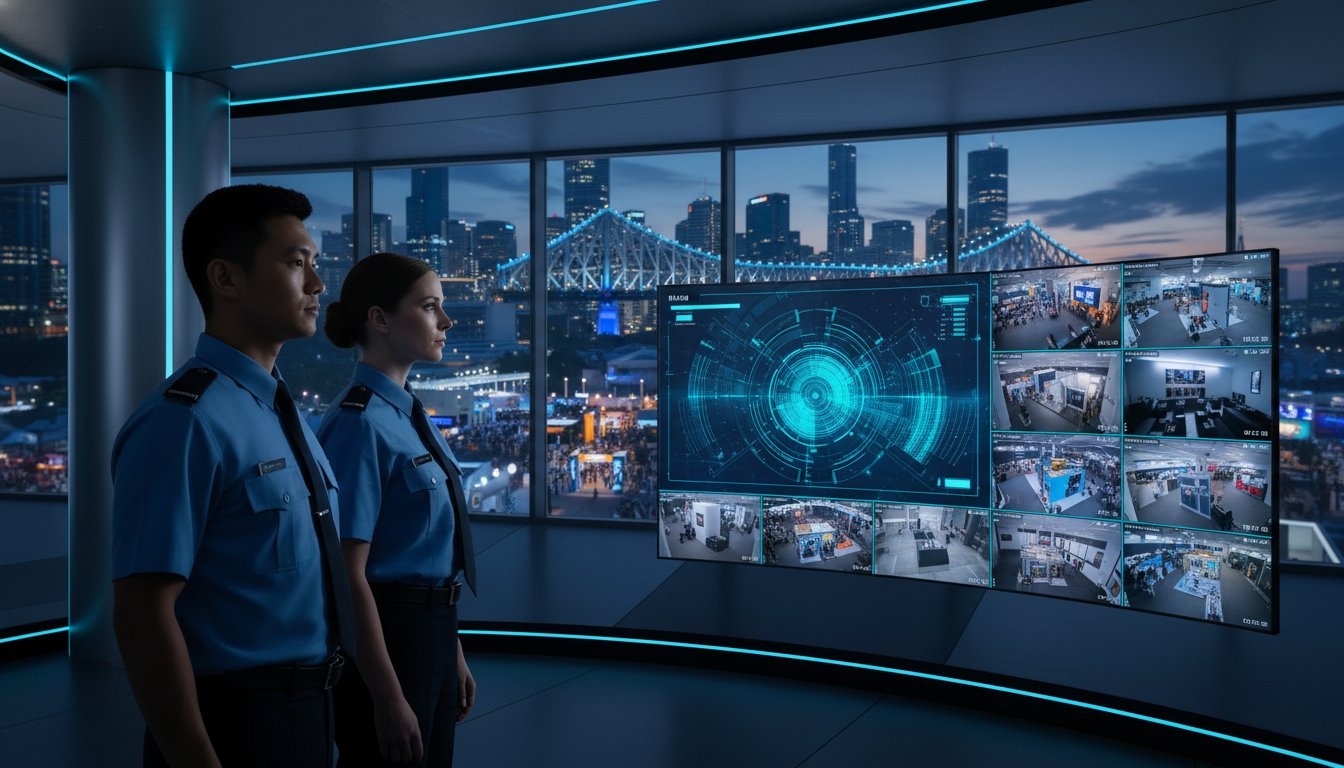
A centralised Security Operations Centre (SOC) serves as the brain of your venue. It’s where the integration of security systems brisbane qld pays off, providing your team with a holistic, real-time view of the entire operation. Following Major event security planning guidelines is a smart move for any project manager looking to mitigate risk before the first patron arrives. By mapping out your hardware needs across these specific zones, you create a scalable security network that protects both people and assets.
Zone 1: Perimeters and Entry/Exit Points
Your perimeter is the first line of defence. High-resolution cameras at gates allow for facial recognition capabilities to manage “banned lists” and identify known troublemakers before they enter. These feeds also help monitor queue lengths to prevent dangerous bottlenecking. If a queue at the main gate grows too long, your SOC can immediately deploy staff to open extra lanes. Integrating these cameras with access control systems ensures that only authorised personnel can move into staff-only zones or VIP areas.
Zone 2: High-Traffic Public Areas and Bars
For Brisbane venues, monitoring Responsible Service of Alcohol (RSA) compliance is a legal necessity. Cameras must be positioned to see both the transaction and the patron’s condition clearly to protect your liquor licence. In high-energy spots like mosh pits or dance floors, overhead views are vital. They help security spot crowd surges or “crush” conditions early, allowing for immediate intervention. We typically use anti-vandal dome cameras in these areas. They’re designed to withstand tampering and physical impact in low-ceiling or high-movement environments.
Zone 3: Back-of-House and Loading Docks
The “bump-in” and “bump-out” phases are high-risk periods for theft and workplace accidents. Loading docks require constant monitoring to protect high-value sound and lighting equipment. Surveillance in kitchens and storage areas ensures safety compliance and prevents internal shrinkage. Don’t overlook the importance of protecting artist and performer dressing rooms. A professional event venue CCTV installation Brisbane ensures these often-forgotten areas are as secure as the front gate. If you need a partner to help map out these critical zones, a tailored security consultation can provide the boots-on-the-ground expertise your project requires.
Selecting the Right Hardware for Brisbane Event Venues
Don’t settle for off-the-shelf kits found in retail stores. Professional event venue CCTV installation Brisbane requires hardware that can track a single individual across a 50,000-seat stadium or monitor a 2,000-square-metre exhibition hall without gaps. Pan-Tilt-Zoom (PTZ) cameras are the workhorses for large-scale venues. They allow operators in the SOC to follow suspects or incidents in real-time with high-optical zoom. For indoor spaces like convention centres, 360-degree fisheye cameras provide a “god’s eye view,” often replacing up to four standard cameras and eliminating the blind spots that plague cheaper installations.
Site protection doesn’t stop when the gates close. Thermal imaging and high-performance low-light cameras are essential for overnight asset protection, especially during multi-day festivals where expensive equipment stays on-site. Managing this data is a significant logistical hurdle. A 4K camera stream consumes massive bandwidth and storage space. Since Queensland regulations mandate a 28-day retention period, your network video recorder (NVR) must be specced for high-capacity throughput. A standard commercial system might average $2,703 for a 4-camera package, but large-scale venue systems with 16 or more cameras often start at $5,000 and scale upwards based on storage and backup needs. Under current regulations, your system must also include a power failure backup capable of at least 15 minutes of continuous recording.
IP vs. Analogue: Why Digital is the Only Choice for 2026
Digital IP systems are the only viable choice for 2026. They utilise Power over Ethernet (PoE), which simplifies mobilisation on complex sites by running power and data through a single cable. This scalability allows event directors to access feeds remotely from any secure device, providing oversight even when they’re off-site. However, high-density networks require robust cybersecurity protocols to prevent unauthorised access. We ensure every networked camera is behind a hardened firewall, treating your digital security with the same safety-first priority as your physical perimeter.
Audio Integration and Two-Way Communication
High-quality surveillance includes what you hear, not just what you see. Cameras with built-in microphones provide vital situational context during an incident. By integrating these feeds with your public address (PA) system, operators can provide immediate crowd direction if they spot a safety issue. Recording verbal interactions at security checkpoints is also a critical tool for liability protection. It provides an indisputable record of staff conduct and patron behaviour, which can be the deciding factor in insurance claims or regulatory audits. We ensure your audio capture meets the minimum requirement of six frames per second to maintain synchronisation with the video feed.
Legal Compliance and Privacy for Event Surveillance in Queensland
Compliance isn’t a box-ticking exercise; it’s a liability shield for your business. The Security Providers Act 1993 dictates that every aspect of your surveillance, from the hardware used to the people watching the screens, must meet specific legal standards. Failure to comply doesn’t just result in fines; it can make your footage inadmissible in court during a liability claim. Ensuring your event venue CCTV installation Brisbane meets the 2026 standards of the Office of Fair Trading is the only way to protect your license and your reputation. You must also display clear signage at every entry point to inform patrons they’re being recorded, fulfilling your “notice of collection” requirements under Australian law.
Data retention is another area where many venue managers trip up. While standard Brisbane liquor licensing requires a 28-day storage period for general footage, any recording of a specific incident must be kept for at least one year. This creates a massive data management challenge. Additionally, if you’re using advanced features like facial recognition, you’re collecting “sensitive information” under the Australian Privacy Principles (APPs). This requires a transparent privacy policy and high-level encryption to prevent data breaches. A professional event venue CCTV installation Brisbane must include a clear data management plan that outlines who has access to this information and how it’s securely destroyed when no longer needed.
Licensing Requirements for CCTV Operators
Monitoring a live feed for security purposes is a regulated activity. You can’t simply task a general staff member with watching the monitors. Anyone performing this role must be part of a licenced security firm in Brisbane. Using unlicensed personnel creates a massive legal loophole that insurance companies will exploit to deny claims. If your event involves aerial monitoring, remember that CASA rules are strict. UAVs must stay at least 30 metres away from people unless the operator holds specific certifications. We recommend keeping all surveillance “boots on the ground” with fixed hardware to ensure 100% compliance with both privacy and aviation laws.
Liability and Evidence Management
Footage is only useful if it’s court-ready. When an incident occurs, you need to export the file in a format that maintains a clear chain of custody. This means the footage must be time-stamped, watermarked, and exported with a digital signature to prove it hasn’t been tampered with. Standard consumer-grade systems often fail here, producing grainy files that lack the forensic detail required by Queensland Police. We prioritise evidentiary quality in every mobilisation, ensuring your system provides the high-definition clarity needed to identify individuals and actions without ambiguity. If you’re unsure if your current setup meets these evidentiary standards, it’s time to audit your venue compliance before your next major event.
The Asset Resources Group Advantage: Professional Venue Installation
Asset Resources Group brings a “boots on the ground” pragmatism to every project, forged in the high-stakes environments of Australia’s mining and construction sectors. We don’t just view surveillance as a tech requirement; we see it as a critical asset for protecting your people and your license. Our team understands the industrial-grade reliability needed for event venue CCTV installation Brisbane. We apply a consistent “Need – Expertise – Result” workflow to every mobilisation. First, we identify your specific crowd density and liability needs. Then, we apply our regional expertise to design a system that meets QLD regulations. The result is a seamless, high-performance security network that works as hard as your ground crew.
A common failure in major venues is the disconnect between the technology and the personnel using it. We bridge this gap by ensuring our hardware integrates perfectly with the operational realities of security firms brisbane. Our systems aren’t designed in a vacuum; they’re built to empower guards and supervisors with real-time, actionable data. Whether you’re managing a remote festival site or a high-traffic metropolitan stadium, our Western Australian and Queensland regional expertise ensures your installation is rugged, compliant, and fit for purpose.
Customised Design and Professional Commissioning
We start every project with a no-nonsense site audit to identify every possible blind spot before a single cable is run. Our solutions are tailored to respect the unique requirements of your site, whether that’s a modern stadium or a heritage-listed hall with strict aesthetic constraints. Once the event venue CCTV installation Brisbane is complete, we don’t just hand over the keys. We provide professional commissioning and training to ensure your staff can operate the system effectively under the high-pressure conditions of a live event. Knowing how to quickly retrieve footage or toggle PTZ cameras during a crowd surge is a vital skill we instil in your team.
Ongoing Technical Support and Maintenance
Operational excellence is inseparable from the well-being of your workforce and patrons. That’s why we provide ongoing health checks to ensure your cameras are clean, aligned, and recording at peak quality before every major event. If a critical system failure occurs, our South East Queensland team is ready to respond rapidly to get you back online. We value long-term partnerships and “doing the right thing” by our clients, ensuring your security infrastructure remains a reliable asset for years to come. Don’t leave your venue safety to chance. Enquire about event venue CCTV installation today and secure your next event with industrial-grade expertise.
Secure Your Venue’s Operational Future
Managing a high-capacity site in South East Queensland requires a shift from basic recording to active, high-density surveillance. You’ve seen how the right hardware layout, from PTZ tracking to 360-degree coverage, eliminates blind spots and supports your ground team. Prioritising event venue CCTV installation Brisbane ensures your business remains compliant with the Liquor Act 1992 and the Security Providers Act 1993, protecting your license from $15,480 penalties. By integrating your digital infrastructure with on-site operations, you create a safer environment for every patron and staff member.
Asset Resources Group is an Australian-owned and operated partner specializing in high-stakes industrial security. We’re QLD Licenced and ASIAL Registered, bringing a pragmatic, results-oriented approach to every venue mobilisation. Our team ensures your technical assets work in perfect sync with your safety-first protocols. Secure your Brisbane event venue with professional CCTV installation to mitigate liability and enhance patron protection. Let’s work together to make your next major event a benchmark for safety and operational excellence.
Frequently Asked Questions
Do I need a specific licence to install CCTV in a Brisbane event venue?
Yes, any individual or company installing security equipment in Queensland must hold a current security provider licence issued by the Office of Fair Trading. Using an unlicenced technician is a breach of the Security Providers Act 1993 and can lead to significant legal liability for the venue owner. Professional event venue CCTV installation Brisbane ensures that your system is commissioned by qualified experts who understand local compliance and evidentiary standards.
Can event CCTV cameras be used for crowd counting and marketing analytics?
Modern IP cameras can be configured with AI-powered analytics to provide real-time crowd counting and heatmapping data. This allows venue managers to see which areas of a festival or exhibition are most popular, providing valuable data for future sponsorship and floor plan layouts. You must ensure your privacy policy clearly states that this data is being collected to remain compliant with the Australian Privacy Principles regarding “sensitive information.”
How many cameras do I need for a 5,000-capacity event space?
A 5,000-capacity venue typically requires between 24 and 40 cameras to achieve total coverage across all five security zones. The specific count depends on the architectural layout, the number of bar service points, and the complexity of entry gates. We prioritise high-density coverage in thoroughfares and “choke points” where crowd surges are most likely to occur, ensuring every square metre is monitored during peak traffic.
What is the best way to monitor CCTV during a live event?
The most effective method is real-time monitoring through a dedicated on-site Security Operations Centre (SOC). Trained operators can spot escalating conflicts or safety hazards on the monitors and immediately direct ground teams to intervene. This proactive approach transforms your event venue CCTV installation Brisbane from a passive recording device into an active response asset that prevents minor incidents from escalating into police matters.
Are wireless CCTV cameras reliable for large-scale outdoor venues?
Wireless cameras are generally not recommended for high-density events because the signal is prone to interference from thousands of patron mobile devices. In a crowded stadium or festival site, the 2.4GHz and 5GHz bands become heavily congested, leading to dropped frames or complete feed loss. We recommend hard-wired Power over Ethernet (PoE) connections to ensure your surveillance remains stable and provides the high-definition clarity required for evidence.
What happens to the CCTV footage after the event is over?
Standard footage must be stored securely for at least 28 days before the system is permitted to overwrite the data. However, if an incident is recorded, that specific file should be moved to an encrypted archive and kept for a minimum of one year. This ensures your venue has the necessary evidence for insurance investigations or legal proceedings that may arise months after the event has concluded.
How does CCTV integrate with my existing alarm and access systems?
Integration is achieved through Video Management Software (VMS) that creates triggers between different security components. For instance, if an intruder alarm is tripped at a loading dock, the system can automatically command the nearest PTZ camera to focus on that specific door. This unified ecosystem allows your security team to verify threats visually before deploying resources, reducing false alarms and improving response efficiency.
Is thermal imaging necessary for event venue security?
Thermal imaging isn’t a legal requirement for most venues, but it’s a highly effective tool for perimeter protection and fire safety. It allows security operators to spot intruders in total darkness or identify overheating electrical equipment in kitchen areas before a fire breaks out. For multi-day outdoor festivals where high-value assets are left on-site overnight, thermal cameras provide a level of “boots on the ground” oversight that standard cameras cannot match.