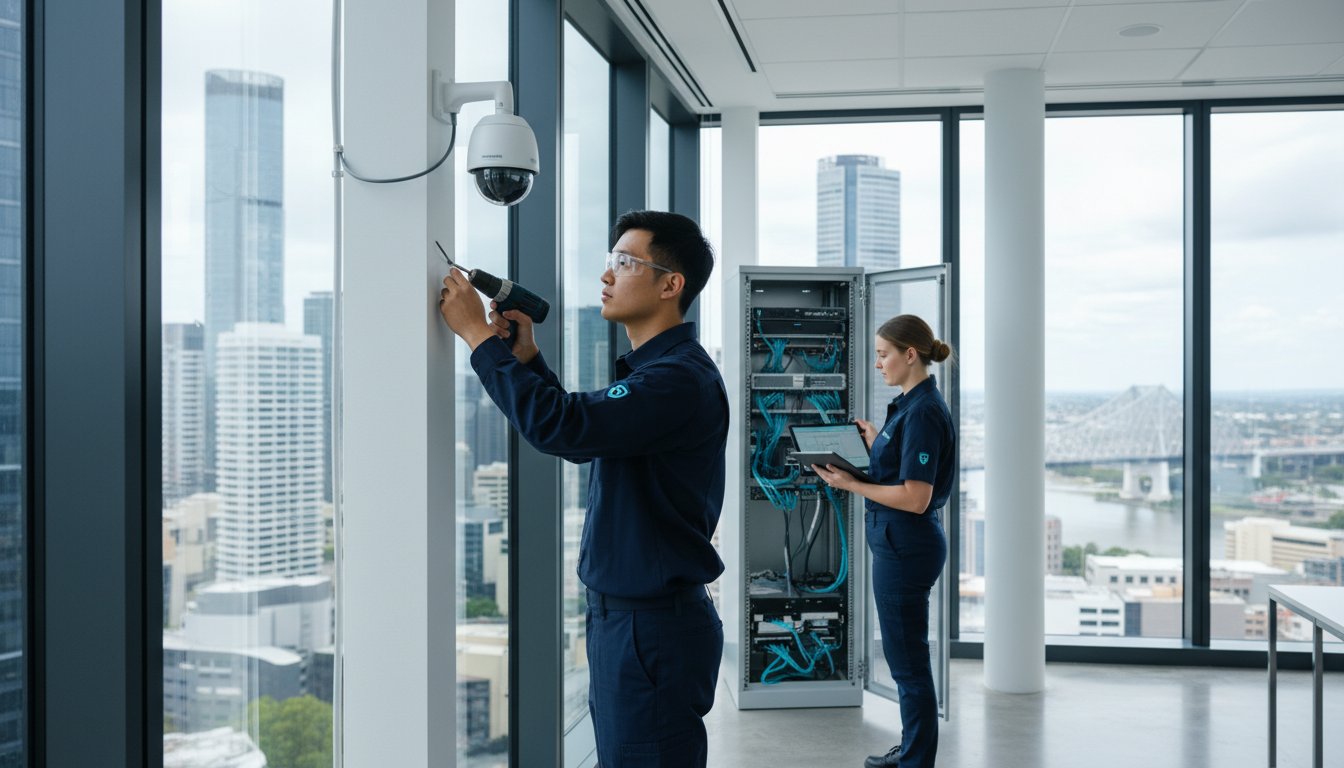
With the Queensland Police Service reporting a 12% rise in unlawful entry attempts across Brisbane commercial zones in 2025, the stakes for your physical assets have never been higher. You likely already know that a few basic cameras won’t cut it when protecting a high-value site or ensuring the safety of your workforce. Coordinating a professional security system installation across complex hardware brands while staying compliant with the Security Providers Act 1993 is a significant logistical challenge. We understand that you need a solution that works from day one, not a series of technical excuses or integration gaps that leave your perimeter vulnerable.
This 2026 guide is designed to help you move from reactive hardware to a strategic mobilisation of integrated technology. You’ll learn how to design a system that meets Australian Standards AS/NZS 2201.1:2007 and AS/NZS 62676 while ensuring your site remains fully compliant with current privacy and licensing laws. We’ll cover everything from managing mandatory licensing fees to deploying high-definition surveillance that provides real-time deterrence, giving you a clear roadmap to secure your commercial operations and protect your most valuable assets.
Key Takeaways
- Learn why commercial-grade hardware outperforms consumer DIY kits in the harsh conditions of Australian industrial and construction sites.
- Master the essential steps of a professional security system installation, from initial risk assessments to final system architecture design.
- Understand how to integrate CCTV, intruder alarms, and access control into a single, seamless perimeter that provides real-time surveillance and evidence.
- Ensure your project remains compliant with the Security Providers Act 1993 and Australian Standards to protect your insurance eligibility and legal standing.
- Discover how a “boots on the ground” approach to site mobilisation ensures your security solution is practical, reliable, and tailored to your specific asset risks.
What Defines a Professional Security System Installation?
A professional security system installation is more than just mounting cameras on a wall. It’s a strategic deployment of industrial-grade hardware designed to protect specific high-value assets. While consumer-grade DIY kits from retailers like Bunnings or Arlo might work for a suburban driveway, they quickly fail in the harsh, high-activity environments of Brisbane’s industrial sectors. These consumer units often lack the processing power for real-time analytics and the ruggedised housing required to survive South East Queensland’s heat and dust. Professional installation ensures that every component, from the lens to the cabling, is selected for its integrity and reliability.
A professional security installation is the deliberate combination of strategic hardware placement, industrial-grade durability, and technical redundancy to ensure continuous site protection.
Commercial vs. Residential Security Requirements
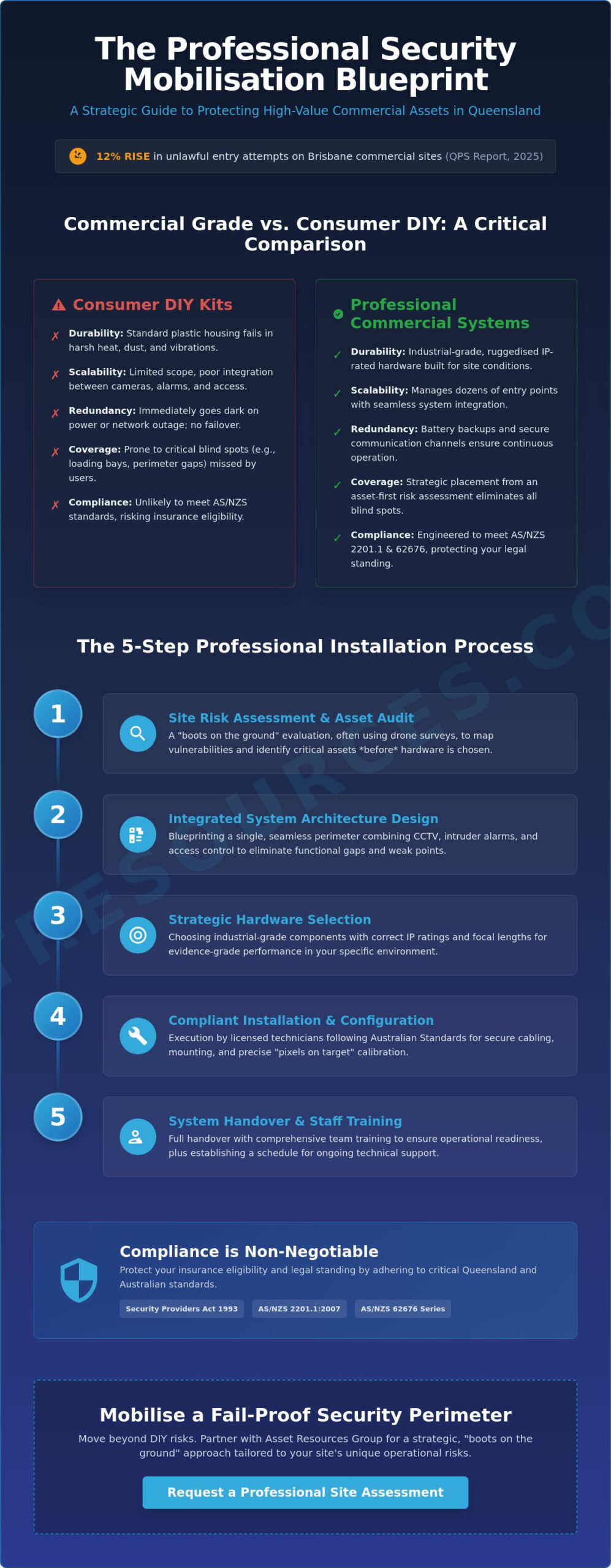
Commercial environments demand a level of resilience that residential systems simply cannot provide. Durability is the first hurdle; a standard plastic camera housing won’t last long on a civil construction site or a remote mining facility where dust and vibrations are constant. Scalability is equally critical. A professional system must manage dozens of entry points and expansive perimeters, integrating seamlessly with access control and intercoms. Finally, redundancy is non-negotiable. If a power outage occurs or a line is tampered with, a professional system utilizes battery backups and secure communication channels to remain operational. A DIY system often goes dark immediately.
The Asset-First Approach to Security
Before a single cable is pulled, we focus on identifying your critical assets. This “boots on the ground” survey allows us to apply fundamental physical security principles to your specific site layout. We don’t just look for where a camera can fit; we identify blind spots that DIY users frequently miss, such as unmonitored loading bays or vulnerable perimeter gaps. This method ensures that your security system installation is built around your operational workflow, rather than forcing your team to work around a poorly designed layout. We prioritise high-definition evidence and real-time alerts for the areas that matter most to your bottom line. By mapping these risks early, we create a fail-proof perimeter that protects your equipment and your people simultaneously.
Step-by-Step: The Professional Installation Process
A high-performing security system installation doesn’t happen by accident. It requires a disciplined, procedural approach that mirrors the rigour of a major construction or mining mobilisation. We follow a “Need – Expertise – Result” framework to ensure every sensor and camera serves a specific operational purpose. This process eliminates the guesswork and technical gaps that often plague DIY setups, providing you with a reliable, evidence-grade perimeter from day one.
- Step 1: Conduct a comprehensive site risk assessment and asset audit to identify vulnerabilities.
- Step 2: Design the system architecture, ensuring CCTV, alarms, and access control work as a single integrated unit.
- Step 3: Select hardware based on the specific site environment, focusing on IP ratings for dust resistance and appropriate focal lengths.
- Step 4: Execute professional cabling, mounting, and technical configuration according to Australian Standards.
- Step 5: Complete the handover with staff training and establish a schedule for ongoing technical support.
Conducting a Site Risk Assessment
The first stage involves a “boots on the ground” evaluation of your entry points, high-value storage zones, and perimeter gaps. We look at the site through the lens of a potential intruder to find the paths of least resistance. For expansive industrial yards or complex civil projects, we often utilise drone property surveys to create high-resolution maps. This bird’s-eye view allows us to plan camera placements that provide 100% coverage without expensive hardware overlap.
Hardware Configuration and Testing
Once the plan is set, the focus shifts to technical precision. We don’t just mount cameras; we calculate the “angle of view” and “pixels on target” to ensure the footage meets the legal requirements for evidence. For a detailed breakdown of how to position your surveillance hardware for maximum coverage and legal compliance, our security camera placement guide Brisbane provides the professional layout principles needed to eliminate blind spots. Testing is equally rigorous for intruder alarms. We calibrate sensors to achieve zero false-triggering, which is vital in industrial zones where heavy machinery or environmental factors can cause issues. We also ensure all access control systems are fully synced with your site’s fire safety regulations. This ensures that in an emergency, doors fail-safe to allow for immediate evacuation while maintaining security during standard operations. If you’re ready to secure your perimeter, our site mobilisation experts can help you design a compliant, high-performance solution.
CCTV, Alarms, or Access Control: Choosing the Right Solution
Effective protection isn’t about choosing one piece of hardware over another; it’s about building a unified ecosystem. Many businesses treat their security components as isolated silos, which often leads to critical blind spots during a breach. A professional security system installation integrates these technologies so they communicate in real time, creating a comprehensive safety net for your commercial assets. When your CCTV, alarms, and access control work together, you’re not just recording an incident; you’re actively managing your site’s integrity. This integrated approach ensures that every “asset” on your property, whether it’s heavy machinery or personnel, remains under a constant, coordinated watch.
The Role of High-Definition CCTV
High-definition CCTV serves as your primary tool for real-time surveillance and operational oversight. For smaller, static areas like office entries, fixed-lens cameras provide reliable, constant coverage. However, for large-scale industrial sites or expansive perimeters, PTZ (Pan-Tilt-Zoom) cameras offer the flexibility to track movement across vast distances. Beyond theft prevention, these systems are essential for monitoring workplace safety and ensuring compliance with site protocols. If a safety incident occurs on a remote mine site, high-fidelity footage provides the necessary evidence for a thorough investigation. Strategic camera positioning is just as important as the hardware itself; understanding the correct angles and mounting heights for your specific environment is critical, and our security camera placement guide Brisbane covers the professional layout tips you need to maximise coverage across every zone. For a deeper look at specific hardware and technical specs, you can explore our pillar guide on CCTV installation Brisbane.
Intruder Alarms and Access Management
While CCTV provides the visual evidence, intruder alarms act as your primary deterrent for after-hours breaches. To be truly effective, alarm systems in Brisbane require back-to-base monitoring. This ensures that a triggered sensor results in an immediate, verified response rather than just a local siren that might be ignored by passersby. Modern access management further strengthens this perimeter by replacing outdated physical keys with smart credentials. This transition allows project managers to maintain detailed audit trails of personnel movement and verify visitors through sophisticated intercom systems before they ever set foot on the main site.
The highest level of protection comes from a unified security ecosystem. Imagine a scenario where an unauthorised entry is detected at a perimeter gate. In an integrated setup, the intruder alarm triggers, the nearest PTZ camera automatically swivels to the breach point, and the access control system locks down sensitive internal storage zones. This level of coordination is what separates a professional deployment from a standard hardware setup. It ensures that your security response is automated, fast, and backed by high-definition evidence that holds up under scrutiny. By choosing a unified solution, you eliminate the technical gaps that intruders often exploit.
Compliance and Standards for Queensland Security
The Security Providers Act 1993 (QLD) is the primary legislation governing our industry in Brisbane. It’s a strict legal framework designed to protect businesses from unqualified operators. As of May 26, 2025, the updated Act reinforces that any person or business charging for the installation of security equipment must be licensed. This isn’t just about red tape. It’s about ensuring the person handling your site’s vulnerabilities is vetted, qualified, and dependable. All professional installers in Brisbane must hold a current QLD Security Provider Licence to operate legally.
When we design your system, we follow the AS/NZS 2201.1:2007 standards for intruder alarms. This standard dictates the design, installation, and commissioning of systems to ensure they perform reliably during a breach. Cutting corners on these standards often leads to insurance claims being rejected after a loss. For surveillance, we adhere to the AS/NZS 62676 series. These benchmarks ensure your security system installation provides the high-fidelity evidence required by the Queensland Police Service (QPS) for verified alarm responses.
Privacy is the other side of the compliance coin. In Queensland, the Invasion of Privacy Act 1971 prohibits recording private conversations without consent. This means audio recording on your CCTV is generally illegal. Section 227A of the Criminal Code Act 1899 also makes it an offence to record people where they have a reasonable expectation of privacy. We ensure your cameras are positioned to protect your assets without breaching these laws or infringing on neighbouring properties.
Aerial Security and CASA Regulations
Large-scale sites in South East Queensland often require more than ground-level sensors. We use drones for high-accuracy site mapping and asset protection. This involves LiDAR drone technology to create precise 3D models of your project site. All our aerial operations strictly follow CASA safety rules to avoid interference with Brisbane’s commercial airspace, ensuring your site survey is both high-tech and high-compliance.
Quality and Safety Protocols
We bake a “safety-first” mindset into every security system installation we perform. This means all electrical components meet AS3000 standards, ensuring your system is as safe as it is secure. We believe integrity is the foundation of any security partnership. You’re trusting us with your commercial assets, and we take that responsibility seriously. If you want to ensure your site meets every regulatory hurdle, book a compliant site audit with our licensed technicians today.
Partnering with Asset Resources Group for Site Mobilisation
Asset Resources Group isn’t just another technology provider; we’re industry veterans who understand that a security system installation is a critical component of successful site mobilisation. Whether you’re breaking ground on a new civil project in the Brisbane CBD or managing a remote resource facility, our “boots on the ground” approach ensures your assets are protected from day one. We don’t believe in one-size-fits-all hardware packages. Instead, we focus on “doing the right thing” by building tailored solutions that reflect the specific risks and operational requirements of your business. This pragmatic mindset allows us to bridge the gap between high-level security theory and the practical realities of industrial work sites.
Our commitment to your operation starts at the design phase and extends through the entire lifecycle of your system, including long-term technical support and scheduled maintenance. We view your workforce and your property as your most valuable assets. By maintaining a safety-first culture in everything we do, we ensure that our security deployments enhance your operational efficiency rather than hindering it. We provide the steady, supportive partnership you need to navigate the high-stakes nature of the resource and construction industries with confidence.
Tailored Solutions for Diverse Sectors
Different industries face unique threats that require specialised mobilisation strategies. Construction sites often need rapid-response security to prevent tool theft and vandalism on active perimeters. In contrast, commercial offices and government facilities demand sophisticated access control and strict regulatory compliance. We have the regional expertise to navigate these varying requirements across Queensland. For example, our work in farm mapping in Brisbane serves as a prime case study in how we apply precision technology to protect large-scale land assets. This project highlights our ability to adapt high-tech surveillance to challenging outdoor environments where standard consumer hardware would fail to perform.
Get Started with a Professional Site Audit
The process of securing your site begins with a comprehensive audit and risk assessment. We don’t just send out a generic price list; our experts conduct a physical site survey to identify real-world vulnerabilities and evaluate your existing infrastructure. This thoroughness ensures that your security system installation quote is accurate, transparent, and focused on your specific outcomes. We’re interested in building long-term partnerships based on integrity and results, not just making a one-off sale. Our team is ready to help you deploy a fail-proof security perimeter that evolves as your project grows. Contact Asset Resources Group for a professional security system installation quote today.
Future-Proof Your Site Security
Effective site protection in 2026 requires more than just high-definition cameras; it demands a compliant, integrated strategy that stands up to industrial wear and tear. You now understand that professional grade hardware and a “boots on the ground” risk assessment are essential for operational safety. A professional security system installation ensures your perimeter meets the Security Providers Act 1993 and protects your bottom line from the 12% rise in local commercial crime reported by the QPS. By moving away from fragile DIY setups, you’re securing your most valuable assets for the long term.
As an Australian-owned and operated business, Asset Resources Group specialises in the unique challenges of South East Queensland industrial security. We combine our technical expertise with CASA-certified drone surveying capabilities to map and monitor even the most complex perimeters. Don’t leave your site’s integrity to chance or unvetted hardware. Secure your assets with a professional Brisbane security installation from ARG. We’re ready to help you build a safer, more resilient operation today.
Frequently Asked Questions
How long does a typical commercial security system installation take in Brisbane?
A standard security system installation for a small Brisbane office usually takes 1 to 2 business days. Larger industrial sites or complex construction mobilisations can require 5 to 10 days depending on the cabling requirements and the number of entry points. We provide a specific timeline during the initial site audit to help you manage operational downtime effectively.
Can I integrate my existing security cameras with a new alarm system?
Integration is possible if your existing hardware supports universal protocols like ONVIF. We assess your current cameras during the risk audit to see if they can be bridged into a new integrated ecosystem. This approach reduces initial capital expenditure while upgrading your overall site intelligence and evidence gathering capabilities.
What are the legal requirements for CCTV signage in Queensland?
Queensland law requires clear, visible signage if cameras monitor public spaces or workplace common areas. Under the Privacy Act 1988 and local state regulations, you must give people “reasonable notice” that they’re being recorded. This transparency is a key part of maintaining regulatory compliance and avoiding legal disputes with staff or the public.
Do professional security systems work during a power outage?
Professional systems continue to operate during power outages by using dedicated battery backups or Uninterruptible Power Supplies (UPS). Most industrial setups provide 4 to 8 hours of standby power as standard. For remote sites, we can integrate solar power or secondary generator links to ensure your perimeter never goes dark when the grid fails.
What is the difference between a wired and wireless security system for business?
Wired systems are the gold standard for industrial reliability because they aren’t susceptible to signal interference from heavy machinery or metal structures. Wireless systems allow for faster mobilisation on temporary sites but require more frequent battery maintenance and have shorter range. We generally recommend hardwired backbones for permanent commercial facilities to ensure maximum data integrity.
How often should a commercial security system be serviced?
You should schedule a professional service for your commercial system at least once every 12 months. This frequency ensures your hardware remains compliant with AS/NZS 2201.1:2007 standards and maintains your insurance eligibility. High-dust environments, such as civil construction sites, often require 6-monthly inspections to keep lenses clear and sensors calibrated correctly.
Do I need a special permit for drone-based security or asset inspections in Brisbane?
Commercial drone operations in Brisbane must comply with Civil Aviation Safety Authority (CASA) regulations. If you’re using drones for asset inspections or site mapping, the operator must hold a Remote Pilot Licence (RePL) or operate under a certified Remotely Piloted Aircraft Operator’s Certificate (ReOC). Controlled airspace near Brisbane Airport adds extra layers of required flight approvals for many sites.
Is professional monitoring worth the investment for my business?
Professional monitoring is a vital investment because the Queensland Police Service (QPS) prioritises verified alarms for a rapid response. Without 24/7 monitoring, a triggered alarm might be ignored during after-hours periods, leaving your assets vulnerable. Many Australian insurers also offer premium reductions of 10% to 15% for businesses with professionally monitored and maintained systems.